Tuesday, October 24, 2006


THE GREEN HORNET

Did you ever get a musical theme stuck in your head, and can’t figure out why?

The other day I found myself walking around humming the theme song from THE GREEN HORNET.

Now I have no idea why; it’s not like this was one of my favorite shows, but the tune is one of those catchy television themes you just can’t get out of your head.

A little research revealed the following.

The Green Hornet was originally a radio series that ran between January 31, 1936 to December 5, 1952.

It was created by George W. Trendle and Fran Striker, who also created The Lone Ranger.

It used “Flight of the Bumblebee" as its theme song.

The series detailed the adventures of Britt Reid, debonair newspaper publisher by day, crime-fighting masked hero at night, along with his trusty sidekick, Kato, a Filipino of Japanese ancestry.

With the outbreak of World War II his Japanese heritage was almost completely dropped, leading to the common misperception that the character's nationality had been switched by the show's writers. (When the characters were used in a pair of movie serials Kato's nationality was inexplicably given as Korean.)

The leading character Britt Reid is explained to be a close relative of The Lone Ranger.

In the original introduction of the radio show announcer
Mike Wallace proclaimed that the Green Hornet went after criminals that "even the G-Men (FBI agents) couldn't reach".

The show's producers were called by FBI chief J. Edgar Hoover who prompted them to remove the line implying that some crime fighting was beyond the abilities of the FBI.

Inspired by the success of the
Batman series, ABC brought The Green Hornet to television in 1966-67, an adaptation which introduced martial arts master Bruce Lee to American audiences and starred Van Williams as the Green Hornet.

Unlike Batman, the TV version of Green Hornet was played straight, but in spite of the considerable interest in Lee, it was cancelled after only one season. However, Bruce Lee’s career skyrocketed from this point. Lee's popularity in
Hong Kong, where he was raised, was such that the show was marketed there as The Kato Show.
While the music of "Flight of the Bumblebee" was strongly identified with The Green Hornet, the theme used for the television series was written by Billy May and was played on trumpet by Al Hirt.

Years later, this music was featured during a key scene in the
2003 film, Kill Bill, which paid tribute to Kato by featuring dozens of swordfighters wearing Kato masks during the film's key fight sequence. (Check the link at the end of this site to hear the theme song for yourself, and tell me if you don’t find yourself humming this for hours!).

The TV series featured the Hornet's car, Black Beauty, which was a
1965 Chrysler Imperial. The car's regular headlight cluster could be flipped over to reveal green headlights. It could fire tiny explosive charges from tubes at its bumpers, which were said to be rockets.

The TV series also employed an audio device from the radio show. In its era, the engines of cheaper cars made a lot of noise; the expensive Pierce-Arrow was reputed to be extremely quiet. So, when the Green Hornet said, "rig for silent running," the hornet-like buzz on the radio show was turned off and the listener was left to imagine that the car really was silent. On TV, the car sounded like a modern car, but the noise was removed from the soundtrack after this command.

Green Hornet Theme Song: http://www.mythemes.tv/series/greenhor.htm


IN LOVING MEMORY

I’m sorry to have learned that RET. DET FIRST GRADE JOHN T. REILLY passed away this past week.

John passed away a week ago Monday (October 16) in South Carolina of congestive heart failure at the age of 77 years.

Readers of this site will recall my often-made reference to John as the eminent department historian.

John worked most of his career in Manhattan Detectives and without a doubt was the greatest living NYPD police historian ever.

He was described by Mike Bosak, another wealth of department history, as “intelligent and wise; he was a consummate perfectionist and displayed unlimited perseverance in the search for forgotten truths”.

John was very instrumental in the work that resulted in the addition of 100 MOS who died in the line of duty over the years who, for some reason or another, had been omitted from the department’s memorial wall at 1PP. He also authored a great text on the department’s medal’s and honor recipients.

John would answer any inquiry I had promptly with accuracy and background to prove a point. I don’t know how he did it, but he will be sorely by missed by all who had the pleasure, in one way or another, to know this fine man.

Truly a kind and gentle, loving person. He will be missed. Our thoughts and prayers go out to John’s family.


RECENT CRIME TRENDS

A recent story in the John Jay College of Criminal Justice “Crime and Justice News” notes a recent nationwide crime trend.

In Many Big Cities, Crime Rises While Police Forces Shrink.

The article goes on to note the following:

“Violent crime increases in many big cities are "reasons for concern but not alarm," says criminologist James Alan Fox of Northeastern University.

Still, Fox believes that the crime picture may be worse than was indicated by a recent Justice Department victimization survey because robberies have increased markedly; the total has remained down in large part because of a decline in reported simple assaults, which Fox says often amount to "people shoving each other."

Fox spoke at a panel sponsored by Criminal Justice Journalists at the International Association of Chiefs of Police convention in Boston. A decline in police staffing has hit many of the same cities where crime is rising, he noted. Cities with populations more than 250,000 have suffered cuts totaling more than 9 percent since 2000, Fox said. By contrast, smaller police department numbers have remained steady.

At the same discussion, Police Chief Dean Esserman of Providence, R.I., lamented that many Americans "seem to accept" the fact that "we lose 16,000 people every year" to homicide, five times as many as were killed in the Sept. 11, 2001, terror attacks. "We are burying our children and becoming used to it," Esserman said. He called for a re- emphasis on "hometown defense" as well as homeland security”.


STOP BY JIMMY’S BAGELS

If you find yourself on Route 109 in the area of West Babylon, near Suffolk County Police Department’s First Precinct stationhouse, stop by Jimmy Leake’s Bagel Shop and say hello. (It’s not called “Jimmy’s”, but you can’t miss it – it’s a block away from the stationhouse).

The shop is located just to the north of the police station, also on the east side of the street.

Jimmy retired from the 77 Precinct a few years back on a medical disability, having survived a motorcycle accident, and spent his last year performing clerical work in the 77 Squad. Consistently tortured by “Loud” Mark Pouria while he was working, some things never change as Mark makes it a point to stop by often to make sure Jimmy’s doing his job properly!

Stop by, say hello, ask for Jimmy – and tell him The Minister of Investigation sent you in. It should be good for a cup of coffee, at least!


INTERESTING WEB SITES

Current Military Service:

To determine if an individual is currently serving in any of the military services, you can use this public information website: HYPERLINK

https://www.dmdc.osd.mil/scra/owa/home

You'll need his/her SSN and last name or last name, first name and DOB. It won't tell you where they're serving, only if they're serving and in what branch.

Cell Phone Carrier:

Det Phil Schurr of the Major Case Squad wanted to pass on this web site which you may find valuable.

Neustar will tell you if a cell number has been "Ported".

You can register for this free service as law enforcement at
www.nationalpooling.com

and go to the law enforcement section. They will assign you a pin number to use.

It appears that Neustar is contracted by the FCC to provide this service.

For example, if you switch your Nextel to Verizon and keep your number, this service will let you know it has been “ported”.


SCHOOL BANS PLAYING TAG

http://www.cnn.com/2006/US/10/18/no.tag.ap/index.html

I heard this one morning as I awoke, as a news story on TV, and wasn’t sure I heard it correctly.

Another example of a litigious society over-reaction?


“LEST WE FORGET…” THE NYPD MEMORIAL

October 19, 1929 Ptl Charles Saver, 76 Pct, Shot-robbery in progress
October 20, 1967 Ptl James Dandridge, 32 Pct, Shot:Accidental by MOS
October 22, 1907 Ptl Eugene Sheehan, 3 Pct, Shot by prisoner
October 22, 1931 Det Guido Pessagano, 20 Sqd, Shot-arrest
October 22, 1970 Ptl Gerald Murphy, 9 Pct, Shot-Arrest, off duty
October 22, 1972 Ptl Joseph Meaders, 63 Pct, Crushed by oil truck
October 24, 1935 Capt Richard McHale, 109 Pct, Shot by disgruntled MOS
October 24, 1939 Ptl Anthony Buckner, 32 Pct, Auto accident on patrol
October 24, 2002 Det Salvatore Cafiso, SI Narco, Heart attack, LOD
October 26, 1897 Ptl Frederick Smith, 14 Pct, Shot-burglary in progress
October 26, 1910 Ptl James Mangen, 144 Pct, Head injury, rescue
October 28, 1888 Ptl James Brennan, 21 Pct, Assaulted during arrest
October 28, 1945 Ptl James Bussey, 18 Pct, Shot-investigation
October 29, 1962 Det John Tobin, BCI, LOD Heart attack
October 29, 1982 PO James Whittington, PBBN FIAU, Shot-off duty

Tuesday, October 17, 2006


A REFLECTION ON TWENTY-FIVE YEARS:
FIGHTING CRIME AND CATCHING CROOKS


It was October 20, 1981 – a short twenty-five years ago – I stood in an auditorium of a forgettable school, raised my right hand, and repeated after another, for the start of my career as a Police Officer in the City of New York.

I started as a member of the Transit Police Department and in March 1995 became part of the Police Department of the City of New York. I can rightly say that I am proud of both!

This Friday will be my 25-year Anniversary. Some call me old, others call me insane – I just call myself proud, and a little bit honored. What more could I ask for?

I grew up around cops – my father spent 32 years on the job before retiring at age 60. I spent summers at The Police Camp in upstate New York, surrounded by other cops families, growing up just a little bit more each year. My father eventually became a Sergeant, and was part of the Bureau. Working in Queens Homicide, with stops along the way at Sex Crimes, Zone Homicide, and Division Robbery in Manhattan.

Mr. Zigo was a Detective, though, and I wanted to be a Detective. Dress nice, show up on the scene of some capers, put crooks away.

I’ve carried six different shields in my left-front pocket over the past 25 years. Do the math, how do I come up with six, with only 4 different ranks?

One Police Officer shield, number 4559. That was replaced by the “gold shield” of the Detective, numbered 934. I chose that number as it was the closest I could get to what was my fathers Sergeant’s shield number – 1934. Transit Detective shields began with a 3-digit 7, 8 or 9 number. I took 934. My promotion to Sergeant saw a new shield, 437, which I carried until it was lost – right before my promotion to Lieutenant – on the one of only a few times I wore it on a belt clip. Never used a belt clip since! My Lieutenant shield from the New York City Transit Police Department was replaced in March 1995 by the one I currently carry, from the City of New York Police.

That’s six shields. I think Jeff Aiello had six PO shields alone!

Always in the front left pocket. Tactical advantage. Left hand accessible, the non-shooting hand. Front pocket, because I carried my wallet in the back pocket – also tactical advantage. (“Give me your wallet” could be complied with the non-shooting hand, right?). Also, I couldn’t see sitting on the shield that meant so much to you. So it’s always in the front left pocket (and NOT on the belt clip).

“You should write a book”, people say. Alright, maybe not a lot of people, but some people anyway. Yes, maybe some day, is always my reply, but really, who would want to buy it?

I had lots of fun along the way. Patrol in District 33, citywide plainclothes task force, Decoy Squad, Detective, Sergeant in Decoys, back in the Bureau, then to Lieutenant and back into the Bureau.

Twenty five years, with twenty of them in Detective Bureau assignments. No reason to be disappointed. I’ve met a lot of good people along the way, and still do. Work should be fun, and it continues to be. Despite the minor (OK, sometimes not so minor) bumps along the road, it’s still a good life.

I used to start my day as a rookie cop donning a uniform, having a cup of not-so-good coffee and some pancakes, work days on through at Central Booking, come back and do it all over again. Make collars, fight crime, put crooks away. A very simple thought for sure.

Today, I start the day with a much better grade of coffee, some oatmeal and a handful of medication (none of them purple, by the way!) and some vitamins, and go off to fight the same good fight.

I’m still driving the Belt Parkway, and it still gets backed up at the slightest hint of rain. I’m still driving through Highland Park, and to Bushwick Avenue, and it’s still dreaded in the early morning and late afternoons!

If I started to begin naming people along the way I know I would unintentionally forget someone. I’ll save some of that for another time; I’ve already taken up too much of your time reflecting on my little career here in Brooklyn.

Indulge me to at least commemorate my Twenty-Five Year Anniversary on this web site. I congratulate all of my brothers and sisters who are doing so for themselves, wherever they may be. Some of them are still on-the-job; more of them have retired, and some of them have passed on.

We’ve become Dinosaurs!

Fighting crime, and catching crooks. I’m very proud to say I’ve spent my twenty-five years on the frontline, chasing bad-guys. You have to be somewhere, that’s where I am. It sure beats the alternative.

“Give me my cuffs for another fifteen years, then I’m getting the hell out”.

Fighting crime, catching crooks.


MEMORIAL

I would just like to mention two very special people I’ve met along the way who are no longer here to celebrate with me. Irma “Fran” Lozada, and Glenn Davidson. A place in my heart is there for you.

Friday, October 13, 2006


NUMBERS

“We can apply a sorting algorithm to these social security numbers and help us take a closer investigative look.”

What the heck does that mean?

Well, that’s exactly what was done on a recent episode of this television cop-show, NUMB3RS.

Yes, I spelled it correctly – this cerebral cop show uses the inverted 3 in place of an “E” in its title – get it? It’s a cop show about… numbers?

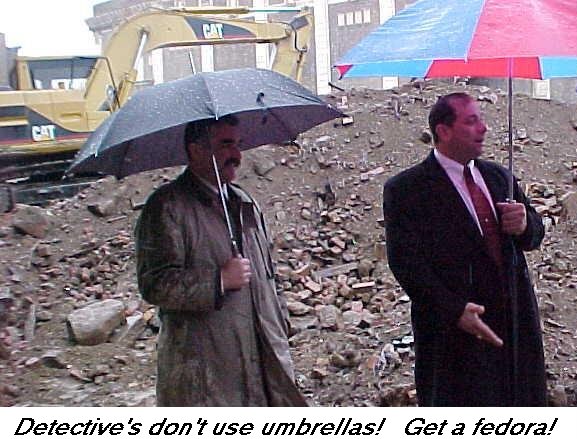
Maybe I’m old fashioned. I still think detectives should wear a fedora in the rain, chomp on unlit cigars, and use phrases like “kid” and “caper”. (And NEVER use an umbrella at a crime scene).

My idea of some good cop-shows include Kojak, Homicide- Life on the Street, and the current running “The Wire”. Give me a good episode of Columbo, even Law & Order or NYPD Blue. But a cop show about “numbers”??

This show, which airs on Friday nights, is described as being “inspired by actual cases and experiences”. I always like the way things are “inspired by” actual events – seems like they’ve taken a pretty broad use of the term in this case. “Numb3rs depicts the confluence of police work and mathematics in solving crime”.

Now, there are probably some real life investigators reading this who are trying to remember the last time they were faced with a “confluence of mathematics and crime solving”. (Incidentally, confluence means a “coming together”, a union or joining together; but you already knew that.)

In the show, an FBI agent recruits his mathematical genius brother to help solve a wide range of challenging crimes in Los Angeles from a very distinctive perspective.

We all use math everyday. Now we are finally able to show the rest of the world the big secret of being a detective – the way we use math to solve murder! The big secret is out!

Now I’ve been asked some pretty crazy inquiries by people in the interest of trying to “help” solve crime.

I’ve been asked if we’ve considered speaking to a criminal profiler, if we thought a hypnotist could help, and even asked if it would help us to speak with a psychic. But a mathematician?

Well, the world already thinks we solve crime by consulting an elderly writer of mystery books. They also think we can wave a wand over some fluid and detect DNA, a la CSI.

Who knew we were missing the boat by not having Professor Algebra on our consulting staff?

Mark my words, one day – probably real soon – someone will be asked at a COMPSTAT meeting whether they had tried to apply a sorting algorithm in an effort to solve the shooting.

http://www.tv.com/numb3rs/show/25043/summary.html?full_summary=1&tag=showspace_links;full_summary&om_act=convert&om_clk=summarysh


FLASHERS AND GROPERS BEWARE

NYC has launched “Operation Exposure” aimed at thwarting out unwanted gropers and flashers.

Check it out at:

http://lawprofessors.typepad.com/crimprof_blog/2006/10/nycs_leads_the_.html


INTERESTING WEB SITE

History of Scotland Yard

http://www.historybytheyard.co.uk/index.htm


ATTENTION ROOKIES

An e-mail that has been going around recently to many law enforcement types has to do with the good-old “Remember when…” tales.

Some of them are rather good, and worth mentioning here for the benefit of those who did not yet see them. You’ll probably find yourself shaking your head in agreement to more than a few of them.

I remember when…

Ink could be blue and guns were black.

Silver guns weren’t authorized because they didn’t look real.

Nightsticks were wood, not plastic.

Gloves were grey.

Everyone in a radio car had a transistor radio because the RMP’s didn’t even have AM radios.

Bosses never had to get involved with cops who didn’t pick up jobs, the other sectors took care of that FACE TO FACE.

You didn’t head inside until you saw the next platoon coming out of the station house; and the next tour made sure they got their a**es out the door so you could come in.

The first order of business for most cops was to get a good cup of coffee. Not chocolate milk, not a protein shake, not a double-mocha-java-latte – just coffee!

Nobody ever wanted the Sgt to handle a job – that could take a whole set of tours before he got over that!

If I may add my own contribution here – Remember when the Sergeant sat in the recorder seat, and the PO drove the boss? How come every time I see an RMP pull into the lot with a Sgt inside, it’s the Sgt that’s driving? Do they not want to be bosses? Do they not know they are not doing their job properly if their driving the car – they’re supposed to be “observing”, making believe they are “supervising”? And where are the Lieutenant’s and captain’s to say something about this?


GET WELL WISHES, SUNDANCE!

Here’s just a note wishing a good friend PHIL PANZARELLA, better known to most as simply “Sundance”, get well wishes as he recovers from his recent surgery.

Phil will be capping off a notorious career by the end of the month, just 10 months short of his 63rd birthday.

There is probably no other living legend to match his fine record, and probably no notorious murder in the borough of Queens in the past thirty years he hasn’t been involved in solving.

A truly vast wealth of knowledge, and still a driven detective. They may have taken a toll on his heart, but he hasn’t lost his heart for this job, and the work we all do as detectives.

As I noted in a previous posting, he is truly a legend!

May I take a moment and salute you, LIEUTENANT PHIL PANZARELLA, a true Commander of Detectives!


“LEST WE FORGET…” THE NYPD MEMORIAL

October 7, 1968 Ptl John Varecha, 18 Pct, Shot-investigation
October 7, 1989 PO William Chisolm, 45 Pct, Shot-off duty incident
October 8, 1900 Ptl Charles Horn, 58 Pct Brooklyn, Stabbed
October 8, 1928 Ptl William Stoeffel, 4 Pct, auto accident on patrol
October 8, 1956 Det William Christmas, 92 Sqd, Shot-off duty incident
October 8, 1966 Ptl James Cosgrove, Mcy4(Hwy3), Auto accident on patrol
October 8, 1993 PO John Williamson, HA-PSA6, head injury-bucket from roof
October 9, 1866 Ptl John Hipwell, 45 Pct Brooklyn, Shot,burglary
October 9, 1928 Ptl Thomas Wallace, Mcy2, Motorcycle accident on patrol
October 9, 1965 Ptl Philip Shultz, HA-B/SI, Shot-off duty arrest
October 10, 1973 PO George Mead, 42 Pct, Shot-off duty robbery
October 10, 1975 PO Walter Tarpey, MSTF, Auto accident on patrol
October 10, 2004 Det Robert Parker, 67Sqd, Shot-arrest
October 10, 2004 Det Patrick Rafferty, 67Sqd, Shot-arrest
October 12, 1946 Ptl George Hunter, 30 Pct, Shot-robbery
October 13, 1968 Ptl David Turman, TPF, Shot-mistaken ID, off duty
October 13, 1970 Ptl Maurice Erben, Harbor, Boat accident
October 13, 1996 PO Brian Jones, PSA4, Shot-off duty dispute
October 15, 1932 Ptl John Fink, 71 Pct, Fire rescue
October 15, 1964 Det James Donegan, 71 Squad, Shot effecting arrest
October 15, 1964 Det Salvatore Potenza, 71 Sqd, Shot effecting arrest
October 15, 1994 PO William Kennedy, Info unavailable
October 17, 1989 PO Anthony Dwyer, MTS, Pushed from roof, burglary
October 18, 1938 Ptl Martin Hanke, 68 Pct, Shot-accidental
October 18, 1988 PO Christopher Hoban, MN Narco, Shot-warrant execution
October 18, 1988 PO Michael Buczek, 34 Pct, Shot-Investigation
October 18, 1996 Lt Federico Narvaez, 70 Pct, Shot-Investigation

Thursday, October 12, 2006

A CLASSIC GUMSHOE LINE

Raymond Chandler’s Philip Marlowe, of private eye-fiction fame, said it best.

“I need a drink, I needed a lot of life insurance, I needed a vacation, I needed a home in the country. What I had was a coat, a hat, and a gun.”


REVOLVERS AS A STATUS SYMBOL?

A New York Times article from 2004 recapped the evolution of the police handgun in New York City history. Some of the more interesting points follow.

In the early years of the Police Department, officers carried any weapon they chose, until Theodore Roosevelt, as president of the Board of Police Commissioners, ordered the 4-inch, .32-caliber Colt revolver to be the standard sidearm.

Training with the guns began on Dec. 30, 1895.

Ninety-eight years later, in 1993, after much debate among the department and the unions and legislators in Albany, the department switched from revolvers to semiautomatics, primarily to meet the advanced weaponry carried by criminals and dispel the perception that the officers were outgunned.

The newer guns were easier to reload and held 15 rounds in the magazine and one on the chamber, almost three times as many as the revolver. Officers with revolvers were allowed to keep them if they chose, while rookies received the new guns.

So, the model of an officer's gun dates him or her like rings on a tree.

The outer bands are the semiautomatic, 9-millimeter pistols.

The next ring is much thinner, the brief period of the so-called spurless revolver, a gun with an internal hammer that for safety cannot be cocked.

Finally, in the center, there is the classic revolver, such as the Smith & Wesson Model 10 or the Ruger Police Service Six, more commonly seen on "T. J. Hooker" reruns or film noir than on the streets of New York.


WHO’S THE TARGET?

Ever wonder who you’ve been shooting at during your police career attending firearms range cycles?

Who is that man on the target?

This question was asked (also by the NY Times, in 2005), and the answer is somewhat complex.

There is a theory kept alive in the basement of One Police Plaza in the printing office, where all of the department's literature – and its targets – are printed.

"That's Bruno," said the deputy director. "That's the guy they sketched it from."

"Bruno" is Bruno J. Fulginiti, a member of the police department from 1951 until his retirement in 1977.

Charles Callahan, a former director of printing, said the target was already in use when he arrived in 1968, but everyone agreed that it looked like Officer Fulginiti.

"Bruno had a resemblance to the guy," he said. "He was a press operator, the old letter press," back when the office was on Centre Street, he said. "It's a very manly appearance."

Officer Fulginiti died in 1996, at age 69. His widow, Marie Fulginiti, said she had never heard about any target. "He's never mentioned it," she said on the telephone from her home in Brooklyn. "If that was the case, he would have told me."

Another theory came from a former commander at Rodmans Neck.

"I call it the Ernest Borgnine Target," he said.

In terms of the film and television actor's celebrity at the time the target was created, the theory is solid. Born to Italian immigrants in Hamden, Conn., in 1917 and a boxer in his youth, Mr. Borgnine had appeared in more than 20 films by the time the target was created, most notably as Sgt. James R. (Fatso) Judson, the bully who beats Frank Sinatra's character to death in "From Here to Eternity" in 1953.

The target was created shortly after the range opened in 1960. It was a busy time, with the firearms officers facing brand-new headaches. Bullets sometimes ricocheted off the target posts and back at shooters, until someone developed an angled pole.

Edwin Love was the first administrative lieutenant at the range. Today he is 83 years old, lives in Bayside, Queens, and suffers from a permanent ringing in his ears. He remembers the primitive target in use when he got there.

"If you took a pen and just made a circle for a head, and you made a little open mouth and a couple of dots - it was Mickey Mouse," Mr. Love said. "As soon as I saw it, I felt, 'We got to change that.' "

"I called downtown and they sent up an artist and he was terrific," he said. "I told him what I wanted. He was a quick study. He did excellent, really. Young guy."

The lieutenant - the man who commissioned one of the iconic images of law enforcement - said that he gave the artist a clear command on who it should look like.

Nobody.

" 'The most important thing, don't make it look like anybody,' " Mr. Love said he told the young artist. His fear, he said, was insulting anyone and singling out any specific racial or ethnic group. Whether the artist obeyed, or he happened to glance up and see Sergeant Worell walking past, or he knew Officer Fulginiti from the presses, or he was a fan of the television program "McHale's Navy," which had its debut around that time, may never be known, for Mr. Love does not remember the artist's name.

He does remember inspecting the finished product, and being pleased, for it did look like anybody, and nobody.

Well... almost nobody. Even a target designed to be nobody, it turned out, reminded everybody of somebody else.

"There was a fighter, Rocky Graziano, I thought it looked like him," Mr. Love said, referring to the former world middleweight champion.

"If it looked like anybody, in my estimate," he said. "it was Rocky Graziano."


GLOSSARY OF SOME 1930’S CRIMINAL SLANG

BULL: a policeman.
BULL-OUT-OF-HARNESS: a plain-clothes man.
[To] BUZZ: to pick pockets.
CADGER: a beggar. (Cadging: begging)
CALL THE TURN: said of a criminal after a detective has identified him.CRIB: a gambling house.
DIP: pickpocket.
ON THE DIP: pickpocketing.
ELBOW: detective.
FLY-COP: a detective.
FRONT OFFICE: police headquarters.
HOLLER: to tell or report to the police.
LEATHER: Pocketbook.
MILKY TOGS: white clothes.
MOB: robbing with companions; Five men generally make up a "mob".
MOLL: a girl.
MOLL-BUZZER: a pickpocket who robs only women.
PETER: a safe.
PETERMEN: safe-blowers.
PORCH-CLIMBER: second-story workers.
QUEER: counterfeit money.


FROM THE 1926 ANNUAL REPORT

The 1926 NYPD Annual Report notes the existence of the Precinct Numeral Shop.

This shop “continues for the manufacture of insignia worn on collars of uniforms of members of the Force, indicating command to which attached. These insignia numerals are furnished without cost to members of the Force and are made by two disabled patrolmen."


SECURITY IN THE PRIVATE SECTOR: FIGHTING IDENTITY THEFT

Some banks will soon be adopting “Voice Print Technology” in an effort to thwart pretexting. (We all know what pretexting is, having read my previous posting, correct?)

Efforts to thwart identity thieves and others who pretext - or falsely obtain information out of banks - may take on a high-tech spin in the near future.

No longer will social security numbers, mother's maiden name and other traditional verifiers be used by bank customer service agents.

Instead, inbound customer calls will be compared to previously secured voice prints of the customer to verify his or her identity.

A product called Omvia, from Intervoice (www.InterVoice.com), compares the voice on the phone with the previously stored, officially recognized, voice for the account.

Interesting, James Bond-type stuff!


INTERESTING WEB SITE

To check on property records for New York City addresses, try this site:

Property tax search:

http://nycserv.nyc.gov/NYCServInquiry/NYCSERVMain

Wednesday, October 04, 2006


CALIFORNIA PRETEXT BILL

What may be of interest to investigators, and which has been receiving some attention recently due to the Hewlett-Packard “Pretexting” investigation, is the whole area of telephone “pretexting”, and legislation being examined in California.

In California there is a legislative bill under consideration which aims to stop anyone, including private detectives and law-enforcement agencies, from pre-texting.

Pre-texting is the practice of pretending to be someone else to elicit information. It will be a sore blow to investigators if it is passed.

In the UK this practice is already very difficult to accomplish while staying on the right side of the law. In America you are not allowed to pretend to be a government official or an official from an exisiting company. You also cannot pretend to be the person whose records you are trying to retrieve, either.

Pre-texting is used to help chance down “bad guys” by law enforcement and private detectives and is very useful as criminals etc. are very unlikely to answer your questions if you identify yourself as a law enforcement officer or a private detective, for obvious reasons.
The main reason for support of this bill is due to Identity Theft concerns. No one wants it to be technically legal for criminals to lie to individuals so they can commit identity theft or another crime.


SOME FAMOUS ONE-NAME DETECTIVES

Two of the most famous fictional one-name detectives continue to pop up as trivial questions.

Probably the most famous is Columbo.

The television homicide Lieutenant, known for his sloppy dress, messy car, and an appearance of not really knowing what he’s doing (a lot like another real-life character who goes by the one-name of Eggers?), Columbo can still be seen on reruns at various times of the day. The shows storyline is usually pretty interesting, as well.

Columbo’s first name is never explicitly revealed in the series. When pressed, he would insist that it was “Lieutenant”. Several sources cite the name “Philip Columbo”, variously claiming that the name was either in the original script for Prescription: Murder or that it was visible on his police badge.

The car he drove in the series, and old, beat up Peugeot, even got him some official notoriety.

The Peugeot company even ran an advertising campaign in which they mentioned “Lt. Philip Columbo” as the most famous driver of the Peugeot convertible.

The name “Philip Columbo” was, in fact, invented by Fred L. Worth, author of The Trivia Encyclopedia, who planted the information in his book (and its sequels) in an attempt to catch out anyone who might try to violate his copyright. Fred’s ploy was, however, only partially successful.

In 1984 he filed a $300 million lawsuit against the distributors of the board game Trivial Pursuit, claiming that they had sourced their questions from his books; even to the point of reproducing misprints and typographical errors.

Trivial Pursuit did not deny they sourced material from Fred’s books (amongst others) and submitted that copying from a single source is plagiarism, but compiling information from several sources is called research. The judge agreed, ruling in favor of Trivial Pursuit, and the case was thrown out of court.

The matter of Columbo’s name was finally laid to rest by the release of the first series on DVD. In the episode Dead Weight, where Columbo introduces himself to General Hollister, the audience is shown a close-up of his badge and ID card, complete with the signature of “Frank Columbo”.

The other famous one-name detective is not really a detective, but a medical doctor. A Medical Examiner, to be more specific.

The television series “Quincy, M.E.”, starring Jack Klugman as the Medical Examiner who took a personal role in investigating the deaths of those he conducted autopsies on, also ran for several years with a lot of success.

Quincy’s first name was never mentioned during the entire Quincy, M.E. TV show run. In episode #33, “Accomplice To Murder”, however, his business card was seen with his name written as “Doctor R. Quincy”.

Jack Klugman often said that the question he was most often asked by fans was, “What is Quincy’s first name?”

He answered, “Doctor”!


THE 5P RULE

Prior Planning Prevents Poor Performance.

This goes hand in hand with one of my favorites:
“Plan your work, work your plan, and your plan will work for you”..


COVERT DOCUMENT EXAMINATION TIP

I came across this item in a recent edition of PI Magazine: The Journal Of Professional Investigators, and thought I’d pass it along. Not sure when you would ever use it, but you never know.

A Forensic document examiner noted he had come across an “off the wall” trick of the trade. Component-cooler, which is available at Radio Shack, can be sprayed on the reverse side of a document that has been whited-out with liquid paper. The paper becomes transparent temporarily and with a hand mirror you can read what was underneath. You can also spray this stuff on an envelope to see what is inside! The advantage of using this product is, if you use it sparingly, when it dries it is undetectable.

I’m not really too sure what use this Component Cooler has. It comes in a can that looks like the spray can you use to clean off keyboards, but is labeled “Freezer” and “Diagnostic Freeze Spray”. The item I saw was a blue can made by “Techspray”.


CONGRATULATIONS!

I’d like to take a moment to recognize some recent promotions in Brooklyn North Detectives to some well-deserving individuals.

Jimmy Kennedy of Brooklyn North Homicide was promoted to Detective First Grade, while Timmy Duffy, also of Homicide, was promoted to Second Grade! Well deserved promotions for both of these murder-sleuths.

Also being promoted from Brooklyn North were Keith Wallen, from the 79Sqd, Silvio Bellissimo of the 81 Sqd, and Joe Tallarine of the 83 Sqd – all being elevated to Second Grade.

Some other noted promotions included Mike Habert of Brooklyn South Homicide to Second Grade, Harry Antoine of Major Case, formerly of the 88 Sqd, to First Grade, and Janice Brocato, currently from the 73 Sqd and formerly from the 83 Sqd, promoted to Lieutenant.

Perhaps with this promotion Janice will make a career move to a more northern part of the city so she can cut back on her three-hour one-way commute to her new home somewhere upstate – it’s far enough away from the city that she needs to program different radio stations into the car radio!

Best wishes to all the promotees!


FOR THE ENGLISH MAJOR

Try to work these words into your DD5’s.

Elucubrate: To produce by working long and diligently. (i’-lu-ku-brate)

Pulchritude: Great physical beauty and appeal. (pul-kru-tood)


“LEST WE FORGET…” THE NYPD MEMORIAL

September 25, 1895 Ptl John Delehanty, 21 Pct, assaulted
September 25, 1953 Ptl Harry Widder, GCP-Hwy3, Auto accident
September 25, 1971 PO Arthur Pelo, HA-BkSI, Shot-robbery arrest
September 25, 1995 PO David Willis, 10 Pct, Auto accident, radio run
September 26, 1977 PO Vito Chiaramonte, HA-CCU, Shot
September 27, 1849 Ptl Thomas Lynch, NFI
September 27, 1945 Det Frank McGrath, 2 Sqd, Shot-investigation
September 27, 1992 PO William Gunn, 67 PDU, Shot-investigation
September 28, 1921 Ptl Joseph Reuschle, 42 Pct, Shot by prisoner
September 28, 1934 Ptl John Fraser, 4 Div, Shot-robbery in progress
September 29, 1854 Ptl James Cahill, 11 Ward, Shot-Burglary **
September 29, 1965 Ptl Donald Rainey, Auto Crime, Shot-Mistaken ID, off duty
September 29, 1983 PO Joseph McCormack, ESU, Shot-barricade situation
October 1, 1963 Ptl John Donovan, GCP-Hwy3, Motorcycle accident on patrol
October 2, 1960 Ptl Philip Curtin, 19 Pct, Info not available
October 2, 1969 Ptl Salvatore Spinola, ESU, Asphyxiation during rescue
October 3, 1913 Sgt Joseph McNierney, 29 Pct, Stabbed during arrest
October 3, 1929 Ptl William McCaffrey, Traffic Div, Auto accident on patrol
October 4, 1928 Ptl John Gibbons, Mcy1, Motorcycle accident on patrol
October 6, 1864 Ptl Charles Curren, 42 Pct Brooklyn, shot during arrest

Friday, September 29, 2006


SOME NYPD HISTORY YOU MIGHT LIKE

I am reprinting the following story, which was written by MICHAEL BOSAK, as it provided some very interesting NYPD history to me, and I thought you might enjoy it as well.

Mike Bosak is a Retired NYPD Sergeant, who I have credited many times on this site, as being probably the eminent NYPD historian.

He was instrumental, along with Ret. Det1 John Reilly, for the inclusion on the 1PP wall of honor of those members who had died in the line of duty but had been omitted; many of them requiring a great deal of historical fact checking to show their death was line-of-duty related.

Anyway, the following may be categorized under the heading “Just Who Was The Highest Ranking Nasty Drunk To Get Himself Jammed Up”.

Thanks again, Mike, for all you do.


“The honor of having the reputation of being the department’s highest ranking nasty drunk to get himself jammed up belongs to none other than James Irving, who was the department’s ‘Chief of Detectives’ from Oct. 17, 1870 to Jan. 22, 1875.

Now before we get started on this little narrative, I know that there are many history buffs out there that are saying right now, “But wait a minute. I remember from my days in the academy (or John Jay), that Thomas Byrnes was NYPD’s first ‘Chief of Detectives’ and he was appointed ‘Chief of Detectives’ until March 12, 1880."

Or perhaps you’re not a history buff but read that fact in one of Thomas Reppetto's many books.

He was great for espousing that Thomas Byrnes was NYPD first ‘Chief of Detective’. BTW in Reppetto’s latest tome, NYPD: A City and Its Police he no longer refers to Thomas Byrnes as the department’s first ‘Chief of Detectives’ Wonder why?

Or just maybe, you’ve visited the Chief of Detectives Office up on the 13th Floor, where Thomas Byrnes picture hangs on the wall as the very first of many.

No matter how you came to believe that Thomas Byrnes was NYPD’s first Chief of Detectives, he wasn’t.

Thomas Byrnes was the sixth man to hold the title of ‘Chief of Detectives’ in New York, and he was ‘Chief of Detectives’ from March 12, 1880 to April 12, 1892, when he was promoted to ‘Superintendent of Police’.

By the way, it was an almost given in 19th Century New York that when you became the ‘Chief of Detectives’ you most assuredly would be the next ‘Superintendent of Police’, which today would be the rank of ‘Chief of Department’.

Incidentally, Byrnes does hold the distinction of being NYC longest serving ‘Chief of Detectives’ and by far NYC’s wealthiest cop ever.

As Chief of Detective and later as Superintendent of Police, he adeptly turned NYC into his very own cash cow. When he was forced to retire by the Teddy Roosevelt, Byrnes was obscenely rich even by today’s bloated standards.

First Some Clarification on Just Who is Who in this Sad Saga

Since we’re on this subject, I know some of you want to know just who NYPD’s first Chief of Detectives was.

That honor goes to George Washington Walling, who will play a very prominent role in this tale of drinking and belligerence.

Known to his friends as ‘Wash’ Walling, he was appointed NYC first ‘Chief of Detectives’ and placed in command “…of the entire detective and detailed forces of the department.” by the Metropolitan Board of Police Commissioners on Friday, May 14, 1858.

George ‘Wash’ Walling was a very outstanding cop; an excellent administrator and was well respected by almost all with the notable exception of NYC Mayor Fernando Wood.

Furthermore, he actually had integrity and great strength of character. Everything that Fernando Wood wasn’t.

It has to be noted here that Walling and Wood had a long history of fierce animosity towards each other. And that hated boiled over with a passion that would effect the department and the history of policing for generations to come

By the way, among NYC historians, Fernando Wood had just the opposite reputation of Walling, one of being one of the most corrupt mayors if not the most corrupt mayor that New York City has ever had the pleasure of experiencing.

This hatred between Walling and Wood would lead to George Walling stepping down as Chief of Detectives in 1860, when that Tammany hack and Tweed favorite, took office for the third and last time as the mayor of NYC.

It started when Walling was the captain of the NYC Municipal Police Department’s 18th Ward (today’s 13th Precinct). Walling refused to accept a convicted felon and known robber, who was one of Fernando Wood political hacks for appointment as a patrolmen in his command.

On April 30, 1856, the mayor had ex-councilman Bryan McCahill file trumped-up charges against Walling for, “Neglect of Duty” alleging that Captain Walling’s men failed to stop “bad boys from pegging stones” at a women’s house on East 21st Street.

Walling was found guilty in the trial room on July 11, 1856 and Fernando Wood fired him. Wood later promoted a patrolman from the mayor’s detail to the rank of captain and made that former patrolman the commanding officer of the 18th District.

‘Wash’ Walling loss of his love and livelihood would not last long. In May of 1857 he was re-appointed to the rank of captain on the Metropolitan Police.

Paybacks a Bitch

As fate would have it, George Walling just happened to be the captain that the Board of Metropolitan Police Commissioners sent over to City Hall on June 16, 1857 to collar the mayor with a felony arrest warrant for assault.

As you probably know, that little unsuccessful act at the time metamorphosed into a major violent confrontation between a detail of 200 New York City’s ‘Municipals’ allied with Mayor Wood’s personal goon squad - the ‘Pugh Uglies’ against one, five and fifty of the ‘Metropolitans’ that went into City Hall Park in the mistaken belief that Walling was in deep trouble and badly needed help.
The true tale of that battle deserves to be told later at another time. (The research is completed, but has yet to be written.)

One last thing, if you want to see what George Washington Walling actually looked like, his picture is hanging in the Chief of Department Office conference room on the 14th floor of One Police Plaza.

Now getting back to Chief of Detectives James Irving; Irving had somewhat of a reputation as one who has a fondness for fighting, not to mention a love of the drink. In other words he was a nasty drunk. Moreover, Irving wasn’t adverse to making a buck or two on the side.

With that said, let me offer this caveat, it was a different time and a different world back in 1870’s New York. Boss Tweed and Tammany Hall were at the height of their power and the New York City’s government was efficiently designed to extract every last penny from the populous.

James Irving was Tweed’s pick for NYPD’s Chief of Detectives during an era when William Marcy Tweed and Tammany Hall ran the big show.

As a young detective in the Metropolitan PD’s 20th Precinct (today’s Midtown South), an alleged intoxicated Irving crashed a New Year’s Eve Party in Turner Hall on West 35th Street at approximately 3 am on January 1, 1863. When the person who was throwing the catered party objected to Irving presence, Irving promptly gave him the beating of his life and then shot him in the chest.

As a tool of Tammany Hall, Irving beat that and many other charges over his police career. Most of which alleged that Irving was intoxicated during the alleged wrongdoings.

As good as an example of just how corrupt NYC was during this time period, among many too numerous to mention, would be an event that would spell the beginning of the end for the Chief of Detectives career.

On October 20, 1873, NYPD’s Chief Clerk Seth C. Hawley preferred charges against Chief of Detectives James Irving.

Hawley on behalf of the Board of Police Commissioners, alleging that the ‘Chief of Detectives’ took a $6,000 bribe from a gang of forgers, who had just ripped off the Bank of England in an elaborate scheme staged in London in March of 1873 for over a million dollars in U.S. currency. Incidentally, the NYPD ‘Chief of Detectives’ annual salary in 1873 was $2,000 a year.

To make a long story short, London’s Metropolitan Police Chief of Detectives Bailey had telegraphed the NYPD with the particulars of the larceny, and that the forgers were heading to New York on the steamship ‘Thuringia’ with the money.

James Irving, being no slouch, got right on the case and decided to handle it himself. He ordered the 24th Pct. (The steamboat Seneca) to take him and one detective out to meet the Thuringia. Irving and the detective represented themselves as U.S. Marshall without mentioning that they were NYPD, and a deal to cut the forgers loose was consummated.

London’s Metropolitan Police, being no slouches in the crime suppression business, also arraigned to have a detective from Montreal, Canada assigned to meet the steamboat as did the New York Stock Exchange. Note that Canada was still a British Province.

When the Montreal detective and the NY Stock Exchange detectives were refused access to the forgers and the counterfeiters were cut lose, somehow or other these detectives smelled a rat and telegraphed London.

London’s Metropolitan Police and the Bank of England then conducted their own investigation.

When the Deputy U.S Counsel General assigned to London, who just happened to be present on the steamboat and witnessed Irving’s conduct with the forgers, agreed to testify as a prosecution witness for the Bank of England, the die was cast.

Britain’s Ambassador to the United States contacted Board of Police Commissioners with their evidence, who then ordered the NYPD Chief Clerk to prefer against Irving and his detective accomplice.
In the department’s trail room, believe it or not, Irving beat all the charges and squashed any chance of being charged criminally. You’re just not going to believe how all this was done. Incidentally, you could make a movie out of this.

The fix is in

Former longtime N.Y. County District Attorney and Ex- NYC Mayor A. Oakley Hall represented Irving as his defense attorney.

Oakley in a brilliant defense blamed it on a mix-up in communications with London’s Chief of Detectives, Inspector Bailey, and on an attempt by the New York’s Sheriff’s Office to embarrass the NYPD.

Then Mathew T. Brennan, a former detective and captain of the old 6th Precinct that covered the ‘Five Points’, and who also just happened to be a former NYPD Police Commissioner and the current Sheriff of New York County, took the stand and testified in the defense of Irving. He claimed that it was two of his deputy sheriffs that had extorted the bribe from the forgers.
Brennan even had two of his hacks to act as ‘straw men’ ready to take the fall for Irving and his accomplice, Det. Philip Farley if things went wrong.

In a nutshell, on November 10, 1873, Oakley on a technicality had the evidence against Irving and Farley thrown out. The Bank of England then chose to withdraw their complaint.

This didn’t sit well with Walling as we shall soon see in January of 1875.

Incidentally as a side note, less than 3 months later, Brennan would be indicted for and occupy the very same Ludlow Street jail that he was accused of helping Boss Tweed escape from.

On July 23, 1874 the Board of Police Commissioners promoted Walling to the position of ‘Superintendent of Police’ and James Irving’s fortune was about to take a turn for the worst.

As Chief of Detectives, Irving had the reputation of being an abusive drunk, but one that was hung like a bull moose with Tammany Hall; something that didn’t sit well with Walling and most of the other ranking brass.

So when Tammany Hall’s abuses came to light and its powers began to wane, the opportunity to do Irving finally presented itself.

A New York Sun Police Reporter Does Chief of Detectives In

In January of 1875 ‘The Shack,’ where most of the city’s newspapers police reporters hung around waiting for a crime story, was located at 301 Mulberry Street, just across the street from the ‘Central Office of Police’

On a side note the ‘Shack’ was originally located in the basement of the ‘Central Office of Police’ 300 Mulberry Street. But when Superintendent of Police John Kennedy found one the reporters snooping around his office shortly after the Civil War Draft Riots, Kennedy had all the reporters ejected from the building. The ‘Shack’ is now located on the 2nd floor of 1 PP next to the office of the Deputy Commish for Community Affairs.

So when the Sun ran an article that James Irving didn't quite appreciate, Irving went across the street to express his displeasure. William Corkran, a police reporter for the New York Sun was confronted by an intoxicated and belligerent Irving in his office at 301 Mulberry Street and got the blunt of Irving fury. According to Corkran, Irving accused Corkran of being a thief and “otherwise abused him” without any cause or provocation.

On January 11, 1874, the Chief of Detectives was arraigned before the Board of Police Commissioner on a charge of “Improper Conduct” for his confrontation with Corkran.

In the trial room, Irving denied the allegations and alleged that Corkran attempted to eavesdrop on him. It was alleged that the Chief of Detectives said to Corkran, “You are a scoundrel. You are a liar. You don’t tell the truth. You are more dangerous than a thief, for you can watch a thief, but not a liar.” Irving said that he was prompted to use such language to Corkran on account of false reports that had been published in the Sun.

On January 22, 1875, President of the Board of Police Commissions George Matsell submitted a resolution to the Board of Police Commissioners to removed Captain James Irving as ‘Chief of Detectives’ and the board votes unanimously to do so.

NYPD Travel Therapy – 1875 Style

Walling then transferred the disgraced former Chief of Detectives to the 24 Precinct, better known as the steamboat Seneca - the very tool Irving had successfully used to extort the bribe money from the Bank of England swindlers. Anybody think that there was a little message attached to this transfer?

No replacement for the ‘Chief of Detectives’ was named and the detective force was placed under the direct command of the ‘Superintendent of Police’ George Walling. (Remember George Walling was the first ‘Chief of Detectives’)
The Board of Police Commissioners then orders that the outer door to the ‘Chief of Detectives Officer from the main hallway of 300 Mulberry Street (Central Office of Police) be “closed up, and no person will be allowed to pass in or out of the Detective Office, except through the Superintendent’s or Inspectors’ Offices.”

Note: The office of Chief of Detective would remain vacant and under the direct command of the ‘Superintendent of Police’ until September 13, 1878, when Capt. James Kealy was promoted to Chief of Detectives.

1875 Police Administration Lesson of the Day – Never Let the Department Drunk Drive the Department’s One and Only Steamboat.

The Seneca wasn’t exactly a tiny little thing like one of today’s police launches. It was a wood hulled side-wheeler, 105 feet long, 33 feet wide with a draft of 12 feet that belched big clouds of black smoke wherever it went. Not exactly easy to hide.

James Irving promptly turned the Seneca into his very own party boat and managed to smash it into a rock that badly crush the steamboat’s starboard’s paddle box, almost destroying the boat according to the N.Y. Times. This brought Irving once again to the department’s attention.

“Irregularities having been suspected in his management in his new position, a watch was kept upon him.”

Once again the Board of Police Commissioners brought charges against Irving for “Improper Conduct and violations of the rules of the department.” The Seneca and Irving having been shadowed 24 x 7 for almost two weeks, Irving was observed personally entering liquor stores in full uniform and stocking the boat with booze. He even steamed out to Long Beach to party.

Irving was charged with ten (10) specifications; specifically that he took the steamboat on “pleasure excursions”.

Irving in a desperate attempt to beat the charges even brought in the notorious Captain Alexander ‘Clubber’ Williams as a defense witness to testify for him. All to no avail.

The Saga's Sad Ending

On October 23, 1875 the Board of Police Commissioners found the former Chief of Detectives guilty on all charges and Irving was “dismissed from the force” In addition, all the sergeants, roundsmen and patrolmen assigned to the Seneca were transferred to other commands throughout the city.


INTERESTING WEB SITES: MEDIA ISSUES IN THE NEWS

Here’s an interesting story about some tactics that have come under question, used by the San Francisco PD, to spy on reporters in an effort to find out who was leaking information to the press.

http://www.sfweekly.com/Issues/2006-09-27/news/feature.html

(You may have to “cut and paste” the site; I don’t think it will link to it directly by clicking on it – but you probably already know that!).


In case you aren’t aware of it, the corporate world has been turning upside down recently over reports that the Board of Directors of giant Hewlett-Packard Corporation had been under secret investigation into information that was being leaked to the press.

What information? Well, apparently corporate strategy, discussed at Board meetings, was showing up on news sites, jeopardizing the effectiveness of the strategy as it was being revealed to its rivals.

What H-P did was hire some private investigative firm, after referral from their corporate Global Security people, to do some investigating.

What they did, though, has resulted in massive disruption of the company, congressional hearings, and firings of top executives.

The procedure used by the investigators consisted of obtaining Board Members telephone records, seeking to find out who had contact with media people.

This wasn’t so bad – but the fact that they did so by obtaining the records through PRETEXTING – which basically means they pretended to be the phone subscriber when they requested the records from the phone companies.

That’s not “proper” – and borders on being illegal.

There is a statute in California that prohibits “pretexting” – and Congress is sure to be considering enacting a similar federal law.

The H-P investigators did not have the ability to subpoena phone records on their own, and had not been able to mask the investigation under a criminal statute in order to obtain them without the subscriber’s cooperation. While the leaking of corporate information was a very real threat to the company, and its profits & losses –which impacts on stockholders – they apparently did not want to bring in federal authorities who may have been able to find some obscure, vague SEC statute to hold against the parties. However, knowing the speed at which the federal authorities operate, I’m sure H-P wanted answers much sooner than the next millennium. Besides, there really is no criminal statute for leaking corporate information to the press, although there probably is some civil matter associated with it.

You can read some of what has been going on at this site:

http://news.com.com/2100-1014_3-6115509.html

and surely, if you Google “HP LEAK”, you’ll have more than enough reading to take you through the week.

Sunday, September 24, 2006


THE LARRY EGGERS REALITY TOUR

A recent posting on this site discussed department “Legends”. Wherever you work, you have your own source of “legendary status”.

As I’ve said, some are legends for the work they performed.

Others are legendary characters.

Anyone who knows him will surely agree, Larry Eggers certainly fits into category 2.

Let me start by saying that Larry Eggers has a heart of gold – I truly love Larry, and I have never heard an ill word spoken of him. He is truly a legendary character.

What do I mean?

Larry retired from this department several months back, having reached the deserving rank of Detective Second Grade. He spent most of his time in the 83 Squad, with the past few years winding out his career in Brooklyn North Homicide. Truly a hard worker, persistent in his endeavors, relentless in his search.

What about his legendary characteristics?

Starting at his origin in the 83 Squad, Larry took off without missing a beat.

If you know Tony Viggiani, you know there are probably no two different people. Tony, himself a legend (as a Detective), and Larry are probably best compared to the Odd Couple, Felix Unger (Tony) and Oscar Madison (Larry).

Tony, an exceptional detective, is very neat and organized. Larry looks like a train wreck. Tony’s desk looks like it could be in a magazine – everything in order, drawers neatly arranged – you get the picture. Larry’s always looked like someone had rearranged the office and left all the debris on his desk – along with a twelve inch stack of catalogs for everything imaginable.

When Larry got assigned to the 83 Squad many years ago he came into the office looking for a place to sit. Detectives being the comics they are saw a good opportunity – Tony Viggiani was on vacation that week – and they told Larry he could “take that desk over there (Tony’s), that detective retired. You could put all his stuff in a box”. Which Larry promptly did!

You can imagine Tony’s ire upon his return, finding his once-neat desk now inhabited by Larry, and all his own items piled in a box. According to Tony, when he opened the drawers, all he found were piles of papers – and some half-opened Twinkies wrappers, with the half eaten Twinkies to go along with them!

So what about this “Reality Tour”?

Since he retired it seems that Larry has gotten involved in conducting tours. Tours, you say? Yes, tours.

He’s stopped in to the office a few times, and tried explaining these “Reality Tours”.

Imagine a van full of tourists; they get the Real-Life New York City tour experience, from a retired homicide detective. He takes them into Brooklyn; drives them around Bushwick, pointing out locations of notoriety – “That’s where I caught a double homicide; that’s where 2 people were shot; that’s where Carmine Galante, a noted Mafioso, was gunned down when there used to be a pizza parlor there”. Things to that affect. “Here’s a real New York City Police Precinct”, those are real NYC Detectives.

I am sure that the tour MUST include some food stops – there truly is no person who knows more about places to eat than Larry Eggers. Larry is like a walking MapQuest of restaurants – give him a location, he’ll give you a restaurant.

“Here’s a Brooklyn Chinese restaurant where real detectives eat at”, or perhaps “this pizza parlor serves great Sicilian slices”. I wonder if it includes the little touches that only Larry could provide.

“This is the shirt I was wearing when I ate there last week; you can tell by the sauce on my sleeves”, and “those are my 3 cars that don’t work anymore, but I leave parked at the precinct because one day I’m going to have them repaired”.

The tour could not end without a “Reptile Safari”. Larry was great with animals – snakes, alligators, lizards, spiders – you name it, Larry probably had it in a tank – or at least in his pocket – at one time or another.

Remember the time Larry brought crickets in to the Homicide Office to feed the spiders he had in a tank – and took them out of his jacket pocket one at a time from the – apparently broken – envelope he was carrying them in? Or the time he reached into – the same jacket pocket – to remove a new lizard to add to the lizard tank?

And what about the infamous snake of the 83 Precinct?

Some years back a resident of Bushwick found a snake in his yard, and didn’t know what to do with it. So he brought it to the 83 Precinct, of course. What would a Desk Officer do with a snake that someone brought into the precinct? Call Larry Eggers, of course.

Larry took custody of the snake, promising to take good care of it. “Leave it in the bag”, he said. “I’ll put it in my locker, and take it home after work”. Famous last words.

You could imagine what he found when he went to his locker at the end of tour – an empty bag!

That snake was observed all around the precinct and its grounds for several years after – sightings in the parking lot, in the bathrooms, you name it. It never was found again, although on a good note, the mice and rat problem ceased for some time as well.

Yes, truly a legendary character, missed every day.

We miss you, Larry. Stop in when you’re in the area – drop by with your “Reality Tour”, and we’ll do the best to entertain.


CRIME LIBRARY

The long-awaited Black Dahlia movie will debut in the U.S. Sept 15. Hollywood's The Black Dahlia movie is loosely based on the 1947 murder of Elizabeth "Beth" Short. Directed by Brian De Palma, the movie stars Scarlett Johansson, Josh Hartnett, Hilary Swank, Mia Kirshner, and Aaron Eckhart.

Find out more about this at:
http://www.crimelibrary.com/notorious_murders/famous/dahlia_movie/1_index.htmlYou

Be aware that the movie is a fictional account of the Black Dahlia murder case.

For the real story and a profile of the type of person who killed her, please go to The Crime Library’s full coverage page where you will find a detailed feature story and the profile by former FBI profiler, Gregg McCrary.

http://www.crimelibrary.com/notorious_murders/famous/dahlia/dahlia_jump_page.htmlA

Another recent feature story at The Crime Library is about a serial killer that you may not have heard about: Patrick Kearney.

When his lover, David Hill, became angry and left for a few days, Kearney, a California aircraft engineer with a good position, would boil over with rage and go cruising for someone to take out his frustrations on. Over a period of time, he killed at least 21 men, mutilated and dismembered them, and finally disposed of them in trash bags.

http://www.crimelibrary.com/serial_killers/predators/patrick_kearney/1_index.html

Editors Note: The links noted above probably will NOT work by just clicking on them. You'll have to "Copy" & "Paste" the addresses in to go to those sites; I apologize for not getting this properly "linked", but, hey - what do you want from me! I'm just getting the hang of photos on the blog!


GUMSHOE

We now use the word gumshoe to informally describe a person who works as a private investigator or detective but the original gumshoe was quite literally something people would wear on their feet.

Gumshoes in the late 1800s were shoes or boots made of gum rubber.

Precursors to contemporary sneakers, these shoes were soft-soled and quieter than other shoes available at the time.

At the start of the 1900s, "to gumshoe" meant to sneak around quietly. Later the word referred to either thieves or the police who caught the crooks. By 1908 the word almost exclusively described the good guys, the people who investigated the crimes by acting stealthily or surreptitiously.The term has also been described a Private Eye who "sticks like gum" to someone as in a surveillance on foot.

It’s probably also what you’ll find in one of Larry Eggers’ pockets.