THE 1855 NEW YORK MUNICIPAL POLICE DEPARTMENT
In 1855, policing New York City was the responsibility of the Municipal Police Department.
There were 1165 sworn ‘members of the force,’ all male, at that time.
The rank structure, though very similar, had a few differences worth noting.
What today would be called a precinct, in 1855 was called a ‘Police District’. Each district had the same geographical boundaries as the ward it took its number from. The alderman from that ward recommended to the mayor who should be appointed to that ward’s corps. Patrolmen from that police district or ward were required to be residents of that ward and were appointed for a term of good behavior. Consequently that ward’s corps resembled the ethnic makeup of that ward. Even though they worked out of a certain ‘Police District’ they would say they were assigned to that (the number) ‘Corps’ rather than say they worked out of a certain precinct. There were twenty two wards in the city, each had its own ‘police districts’ or ‘corps’.
The Reserve Corps: Chief Matsell established the “Reserve Corps” in 1853 as an elite unit of approximately 100 of the best and most competent patrolmen and sergeants. By 1855 it numbered approximately 150 men. They were assigned to the chief’s office and other high profile assignments such as detective duty, the courts and various other details, etc. On occasion, the reserve corps would fly to various areas of the city and were used for duties similar to those performed by today’s Borough Task Forces.
‘Doorman’ – There was one to each corps. He took care of the cells and other various chores around the station house. Annual salary - $550.
Patrolman (1011): He was either a “Star” (Uniformed) or “Shadow” (Detective). Both received the same salary. However, by law the uniformed ‘Star’ was required to live in the ward he worked in. Salary was $700 annually, except for those assigned to a detail (Reserve Corps). They were all paid by law $100 less annually. In other words, if you were on patrol, you got paid a 17% premium for being on the street and going around the clock. There was no pension or insurance system to provide for a patrolman’s family, should he be killed or disabled in the line of duty.
‘Sergeants’ – None were assigned to patrol commands (police district). All sergeants were assigned to one of the reserve corps’ 21 squads. They were paid exactly the same as a patrolman - $700 annually.
Lieutenant (44) – There were two assigned to each patrol district. – One 1st lieutenant and one 2nd lieutenant - forty-four lieutenants for the whole department. Annual salary - $800.
Captain (22). One assigned to each ‘police district’ as its commanding officer. Annual salary – $900.
Uniform: Gray trousers with 1” black strip down each leg, dark blue jacket made of light material with 9 brass buttons, belt, blue cap and black shoes.
Batons: The everyday work baton for both bosses and patrolmen was 22” long and 1¾” thick, made out of rosewood. It has to be noted here that the city watch used locust wood or whale bone prior to the Municipal Police Department’s use of rosewood. The Metropolitan Police brought locust wood back into vogue after the rosewood batons frequently splintered during the July 1863 Civil War Draft Riots.
Firearms: None of the uniformed members of the force were armed with pistols or revolvers. All police officers were only authorized to carry batons.
The Department Motto: “Fiat justitia ruat coelum. Partum est Merito.” –was the motto of the 1845 – 1857 NYC Municipal Police Department.
English translation: “Let justice be done, regardless of the consequences. The duty in itself is the reward.”
When the New York City Municipal Police Department was legislated out of existence and the state controlled Metropolitan Police began to police the city in June of 1857, the old motto went the way of the department and became lost to history.
On June 13, 1873, legislation changed the name of the new ‘New York Municipal Police’ (Established April 5, 1870) to the ‘New York Police Department’, and the motto was codified as, “Fedelis ad Mortem”, English translation: "Faithful unto Death"
DETECTIVE DIVISION AND COBS
The 1964 Detective worked in what was known as the Detective Division. “
The detective of today is a far cry from the roundsmen, known as “shadows”, of 1836 or the twenty policemen detailed as detectives by the Board of Police back in 1857.”
The 1964 Detective Division was comprised of 3,400 men and women, selected for their special skills and trained for long arduous hours in improving their talents and developing other detective faculties.
There were three major commands in the Detective Division at that time.
The Detective Borough Commands comprised the precinct detective squads and the specialty, borough based Homicide Squads, Burglary Squads, and the DA Office Squads.
The Narcotics Bureau was under the command of the Detective Division.
The third component was the Central Office Bureaus and Squads – known as COBS.
COBS consisted of the specialized headquarters commands such as the Auto Squad, Forgery Squad, Pickpocket & Confidence Squad, Missing Persons, the Police Lab, Ballistics Squad and the Bomb Squad. Generally the “letter” squads of today.
The Safe, Loft and Truck Squad was one of the components of COBS that came under the “Special Frauds Bureau”.
Safe, Loft and Truck was known for their vigilance of long hours of surveillance spent in shadowing known criminals casing well-stocked lofts, laden trucks and posh hotels. The detectives in this elite command were chosen for their ability to act the part of nondescript bystanders, and were well trained in the techniques of safe-crackers and hijackers. The fur and garment districts, jewelry exchange, and upper-class hotels and apartment houses were under their watchful eye, particularly during the night hours. During the day their tail work highlights spotting thefts of packages from parked trucks and loading platforms.
KEEPING UP WITH THE CORPORATE WORLD
Think only gumshoes use jargon in their everyday speak? Think again.
The corporate world is rife with buzzwords-of-the-moment. MBA candidates spend months just familiarizing themselves with these key-phrases. Next time you find yourself at a corporate-type function, perhaps at a cocktail hour with your less-then-best-brother in law? – here’s a few new buzzwords to throw around.
Limited downside: This can certainly work its way into our world. Basically, this means that “things can’t get much worse.” I’ve had my share of “limited downside” weeks, haven’t you?
Delayering: When a CEO talks about “delayering”, what he is saying are that managers are going to get fired.
Knowledge acquisition: Getting the right people, with the right knowledge, to work for you. We recently engaged in some knowledge acquisition when we moved some anti-crime cops upstairs to the squad.
Skills development: Teaching the current staff new skills instead of hiring new people. We have been engaged in conducting skills development with the new computerized DD5 system, teaching detectives to return to the squad and teach other detectives how to use the new system.
Unsiloing: Getting people to work together across departments. If you’ve spent more than ten minutes in the department then you know how difficult this could become. Maybe we need to perform some knowledge acquisition tasks so that we can begin unsiloing the levels in the agency?
A common corporate buzzword today refers to the 2002 corporate governance reform act, the Sarbanes-Oxley Act, commonly referred to simply as “SOX”.
In corporate America, if someone wants to stop something from going forward in a company, all they have to do is ask, “Will this pass SOX rules?” That’s sure to stop CEO’s in their tracks. We simply say, “We don’t do it that way”, or “We’ve never done it any other way”.
RESTORING DRY CIGARS
One of the most important steps in restoring dry cigars is patience, and lots of it.
It’s always good to remember that if moisture can escape from a cigar, it can be
put back in it. If a cigar is dry it can be revived, but it may be difficult.
There are different methods to restoring dry cigars. The most important thing to
remember is that this is a slow process, and the cigars need to go through a
couple of phases of thawing and/or a slow introduction back to humidity before it
can be put into a functioning humidor or exposed to any sort of higher humidity
levels.
Some people store their cigars in the freezer. This is something that many
people do but is not advisable as it can easily damage a cigar. Freezing cigars
prevents aging, it will dry them out and the cigars will need to be returned to
normal temperature slowly before they can be smoked, (otherwise they could
split or crack).
The cigars should have a solid two to three weeks at the proper temperature in a humidified environment before lighting them up in order to ensure the best possible smoking experience.
If you don’t store your cigars in a freezer and they dried out at room
temperature, a great method is to place a box inside a plastic bag.
Be sure the bag is not completely closed because some airflow is actually desired. A dampened sponge with water or 50/50 solution should be placed in the bag.
This process can take several weeks or a month.
Rotate the cigars every few days, bringing the ones on the bottom to the top, etc. If this is done properly the result is usually successful and pleasurable. If a cigar box is not available, other containers like Tupperware may be used.
Personally, I’ve always found the Tupperware container to be the best; it actually makes one of the best humidors as well!
Put the dry cigars in the container and seal it for a couple days - this traps any moisture left in the cigars.
On the third day a damp sponge can be added, but don’t over-saturate the
sponge so the cigars become moist too quickly. Keep the lid propped open in
one corner so air can circulate.
When cigars lose moisture, they also lose much of their bouquet, and which
together results in a cigar not tasting as good as one that has been properly
humidified.
The most important factor that needs to be reiterated, is that this is a
slow process.
With patience the wait is usually always worth it.
INTERESTING WEB SITES
Double-Blind Lineup Procedures:
http://www.mass.gov/cpcs/links/index.htm#lightening1
The Eyewitness Identification Research Laboratory, at the University of Texas, produced a 2006 study, in conjunction with various Illinois law enforcement agencies, Report to the Legislature of the State Of Illinois: The Illinois Pilot Program On Seqential Double-Blind Identification Procedures.
http://eyewitness.utep.edu/Documents/IllinoisPilotStudyOnEyewitnessID.pdf
Investigators Guide To Sources Of Information
http://www.gao.gov/special.pubs/soi.htm
“LEST WE FORGET…” THE NYPD MEMORIAL
September 12, 1968 Ptl John Madden, 104 Pct, LOD Heart attack
September 12, 1991 PO Hector Fontanez, 47 Pct, Shot during investigation
September 13, 1928 Ptl Jeremiah Brosnan, 24 Pct, Shot by perp
September 14, 1931 Sgt Timothy Murphy, 8 Pct, Shot-robbery in progress
September 14, 1974 PO Bruce Anderson, 32 Pct, Auto accident on patrol
September 15, 1931 Ptl William Eberhardt, 15 Pct, auto accident on patrol
September 15, 1979 PO Melvin Hopkins, 77 Pct, Shot, robbery, off duty
September 16, 1927 Ptl Henry E.A. Meyer, 54 Pct, shot-robbery arrest
September 16, 1975 PO Andrew Glover, 9 Pct, shot-assasination
September 16, 1975 Sgt Frederick Reddy, 9 Pct, shot-assasination
September 16, 1977 PO Daniel Nowomlynski, 23 Pct, shot-off duty
September 18, 1927 Ptl Jerome DeLorenzo, 4 Pct, Shot-accidental discharge
September 19, 1943 Sgt Mathew McCormick, 120 Pct, Auto accident on patrol
September 21, 1952 Det Philip Lamonica, 42 Sq, Shot during arrest
September 21, 1984 PO Irma Lozada, TPD D-33, Shot-robbery arrest (RIP, Fran!)
September 22, 1946 Ptl William Brophy, 109 Pct, Auto accident on patrol
September 22, 1983 PO Joseph Hamperian, TPD-SCU, Struck by auto
September 22, 1987 PO Robert Venable, TPD-D33, Shot during arrest
September 23, 1896 Ptl Thomas McIntyre, MTD, Horse accident
September 23, 1937 Det John Wilson, 1 Pct, Shot-robbery
September 23, 1941 Ptl James Schowers, 28 Pct, LOD heart attack
September 23, 1970 Ptl Michael Paolilo, IdentUnit, Stabbed-off duty investigation
Monday, September 18, 2006


Tuesday, September 12, 2006

MORE ON JOHNNY CORDES: A LEGEND IN HIS OWN TIME
We all know people who consider themselves a legend in their own mind – but JOHNNY CORDES is truly a LEGEND IN HIS OWN TIME.
As mentioned in a prior posting to this site, JOHN CORDES is one of only 3 members of this department who have ever received two Medals’ of Honor – and he is the only live recipient of the second award.
The following story was written by Retired Det1 John T.M. Reilly – a true department historian who never ceases to amaze me with the knowledge he possesses. I thank John once again publicly for all he has done, and continues to do, in the name of keeping the New York City Police Department and its members in such high esteem.
The exploits of a member of this department such as JOHN H.F. CORDES should be known by all who carry the shield of the NYPD – and should be taught to those who enter this profession, in the Police Academy, the way the US Marine Corps teaches its newest grunts during Basic Training.
Thanks again, John Reilly, for the following.
A LEGEND IN HIS OWN TIME
John H.F. Cordes joined the New York City Police Department on August 24, 1915.
While still in the Police Academy he was picked, because he did not look like a cop, to work on vice and gambling enforcement. After less that three years in plainclothes arresting gamblers he was made a detective on February 11, 1918. The rest of his
thirty-four year career was spent in the Detective Division, during which he was twice awarded Department Medal of Honor.
At about 9pm on March 29, 1923, while off-duty Cordes became suspicious of two men who had entered a United Cigar Store at 954 Lexington Avenue between Sixty-ninth and Seventieth Streets.
Waiting a few minutes he followed them into the store and found them in the process of robbing the store.
After entering the store one man, Patrick Ahearn, had stayed in front of the counter, while the other, John Whitton alias John Insford - an escaped convict from East View
Penitentiary in Westchester County - walked behind the counter, drew a .45 caliber pistol from his coat pocket, then ordered the clerk, William Horn, to open the safe. The safe was opened by Horn and the robber pocketed $80 taken from the safe.
As Cordes and his brother walked into the store, one of the robbers ordered Horn to "Wait on them." Sizing up the situation Cordes drew his pistol; as he did so
another man entered the store. This man was also a policeman, off-duty Sergeant McDade, who seeing Cordes covering the two men behind the counter, opened fire on Cordes believing him to be a robber.
McDade fired four shots at Cordes hitting him three times.
Cordes fired at Ahearn in front of the counter; he dropped to the floor wounded.
Whitton, also behind the counter, fired at McDade; as he did so Cordes cried out
"I'm a police officer." Then both Cordes and McDade fired at Whitton behind the counter. Whitton continued to fire at the officers, hitting Cordes twice. Hit in his right hand and arm Cordes had to fire with his left hand. With his revolver empty McDade backed up to the door, opening it he then blew his whistle for assistance. Blocking the door he prevented the wounded Ahearn and Whitton from leaving the store until other police officers, alerted by his whistle calls, arrived and took the two robbers into custody.
Cordes was rushed to Presbyterian Hospital where it was found that he had been shot five times, twice by the robber and three times by the police sergeant. Bullets had struck his right shoulder, his right arm twice, his jaw, and another had passed through his right
hand.
At first little hope was given that Cordes would recover from his wounds; the intern who first examined him told reporters that it was just a matter of hours before he died.
But he did recover, and when Mayor James Walker visited him in the hospital and offered to retire him on a full pension, he refused the offer, saying that his only fun in life was putting hoods in jail.
He returned to duty and at the 1924 medal ceremonies received the Department Medal of Honor.
The Official Police Department Citation for The Medal Of Honor reads as follows:
Acting Detective Sergeant John H.F. Cordes, Shield No. 472, Detective Division, at about 7.50 p.m., March 29, 1923, while riding south on Lexington Avenue in an automobile, observed two men enter the United Cigar Store at 954 Lexington Avenue. Being suspicious, Detective Cordes entered the store under the pretense of purchasing cigars. Two men were behind the counter, and as the detective asked to be waited on, one of the men ordered the other to wait on the detective. From their actions Detective Cordes concluded that they were impostors, and made known his identity. One of the men drew a revolver and fired, the bullet hitting Detective Cordes' right thumb. As one of the men came from behind the counter Detective Cordes fired, though injured, the bullet entering the criminal's abdomen. The man who previously fired at the detective fired three more shots, and one of the bullets lodged in Detective Cordes' shoulder. Despite his injuries the detective covered his men and summoned assistance. He was in the hospital and on sick leave for six months.
Police Department regulations required that all police officers carry their firearms at all times, even if off duty. It is noted that following the United Cigar Store shoot-out Cordes constantly violated the rules by not carrying his weapon.
When asked why he did not carry his revolver he would reply that he was still afraid that he might get confused in times of stress and shoot a fellow officer as he was shot.
Because of this answer his superiors overlooked his violation of the department rule. In 1927 because he had left his gun back in his locker it almost cost him his life.
On April 28, 1927, kidnappers abducted wealthy real estate operator Abraham Scharlin and demanded at first a $500,000 ransom which was later reduced to $200,000.
A team of six detectives from the Main Office Squad which included Cordes and his partner Detective Frank Walsh was given the case.
Acting on a "stool pigeons" tip that a criminal known as Jack Thompson, alias Joe Marcus, was part of the gang, Cordes and Walsh, who both knew him, placed him under surveillance.
On May 6th Marcus was seen to meet with another man later identified as David Berman, known as "Dave the Jew", at Broadway and Sixty-third Street. As they walked in the direction of Central Park, Cordes saw Berman shift a pistol from his hip pocket to the front of his belt.
While the two criminals were watching some boys playing ball in the park, Detective Walsh went to find a telephone to call Headquarters. Cordes remained in the park keeping the pair under observation. Right after Walsh left to make the phone call, Marcus and Berman started to leave the park.
Cordes, fearing that they would separate and he would lose them, hurried out to the street.
With Walsh nowhere in sight, he motioned to Motorcycle Patrolman Richard O'Connor and told him to cover him. Marcus and Berman came out of the park at Sixty-second Street, walked up Central Park West and turned into Sixty-sixth Street. Cordes had followed them, while O'Connor had dismounted from his motorcycle and stayed further back.
Berman stopped in front of 6 West Sixty-sixth Street, and Cordes decided to make his move.
As he closed in on them, Berman suddenly made a move to draw the pistol from his belt.
Cordes jumped at him, grabbed his wrist, gave it a quick turn away from the gun, then grabbed it himself striking Berman over the eye and knocking him down to the pavement.
While Cordes was subduing Berman, Marcus backed away a few feet, drew a pistol and aimed at Cordes.
Patrolman O'Connor, who was rushing up to assist Cordes, saw the gun aimed at the detective and fired one shot that struck Marcus in the stomach, dropping him to the sidewalk.
Marcus was removed to Roosevelt Hospital where he died shortly after.
Berman who had received a two-inch gash over his eye was taken to the West Sixty-eight Street Station House.
When questioned he refused to say anything other than "I can't tell you anything, do you think that I want to get in any deeper than I am." A search of Mascus' clothes disclosed an Elk membership card belonging to Scharlin and a number of checks belonging to a James Taylor, another kidnapping victim. The next day the gang released both Scharlin and Taylor and made their get-away.
For his part in the arrests of Berman and Marcus, Cordes received his second award of the Department Medal of Honor.
Patrolman O'Connor was offered promotion to Detective, but declined it saying that he preferred to remain on motorcycle duty. At the 1928 medal day ceremonies he received the Charles H. Sabin medal.
The Official Police Department Citation for his Second Medal Of Honor reads as follows:
Detective John H.F. Cordes, Shield No. 472, 17th Division. At about 4. p.m., May 5, 1927, had two notorious criminals from Chicago under surveillance and intercepted them on 66th Street near Central Park West, Manhattan. Previously he had directed a patrolman on motorcycle duty to be on the alert for emergency assistance. As one of the men was about to shoot Detective Cordes, the patrolman shot and killed the thug. The other was disarmed of a loaded revolver and arrested.
Cordes was promoted to Sergeant on February 15, 1928 and on March 2, 1934, to Acting Lieutenant. In 1938 he was given command of the Manhattan Riverfront Squad. He retired from the department on January 1, 1950. He died at the Hollywood Memorial Hospital, Florida, April 19, 1966, at age 76 years.
Special Note: During the modern era of NYPD awards from 1912 to date only three members of the department have been awarded the NYPD Medal of Honor twice. John Cordes was the only live recipient of two awards.
WHAT ABOUT LEGENDS?
Who qualifies as a “legend”?
Certainly John Cordes does. I’d have to add Frank Malerba in the same category.
Who is Frank Malerba? He’s another detective legend, written about previously on this site. More on Malerba at a subsequent posting. (Too much for one sitting!)
Is John Medina, retired from the 83 Squad a legend? If you lived in Bushwick in the 1980’s – or worked in the 83 – you’d probably think so. Charlie Wells is certainly another legend. Recently retired Inspector from DBB, he made his mark early in the Bomb Squad, dismantling bombs when it was done in a suit and tie – before all the protective equipment. You could have sat there for hours upon hours being regaled with stories involving Charlie Wells – a true legend in his own time. How about Vinny Carrera of Transit Major Case fame? Legend status, perhaps? Or John Clinton from Transit’s Robbery Squad (the original one); not to forget Tommy McGurl – the very best at getting a statement “in the box” from a perp. Legends, for sure.
Wherever you work you surely have a few who have reached legendary status. Eddie Zigo, Sonny Grosso, Tommy McKenna, Jerry Giorgio, Jerry McQueen … Hopefully, as you’ve encountered these legends in person, you’ve been able to take something away that makes you a better detective – education never ends.
INTERESTING WEB SITES
High Tech Crime Investigation Association
http://www.htcia.org/
Financial Crimes Enforcement Network
http://www.fincen.gov/.
IACP Law Enforcement Info Management
http://www.iacptechnology.org/
United Nations Crime and Justice Info Network
http://www.uncjin.org/
Friday, September 01, 2006

FRANK MALERBA AND MADIGAN
When Frank Malerba passed away on December 23, 2001, the NY Daily News mentioned in his obituary how this long-retired police detective had captured a robber and, in an ensuing struggle, shot the man in the leg.
A week later, the late Mike McAlary wrote a piece that went on to chronicle the police exploits of Det1 Frank Malerba during the 1950's, highlighted by an infamous shoot-out in East Harlem with a hit-man named August Robles.
It was noted that this true Detective "legend" FRANK MALERBA had, in 1955, shot a barricaded murder suspect named August Robles and inspired the movie "Madigan", starring Richard Widmark. The suspect, Robles, had committed a murder in Brooklyn, and had fled to a relative’s apartment in the 23 Precinct in Manhattan. A snitch for the 23 Squad gave up the perp, and the events that transpired were used as the basis for the very good, hit movie “Madigan”.
On Friday, February 18, 1955 Robles had fled after committing his Brooklyn murder and was held up in his nieces apartment on West 129 Street. After working on leads that they had developed, four detectives from the 23 Squad, including Frank Malerba, went to the apartment seeking to apprehend Robles. As they stood outside the door, Robles appeared, gun in hand from another doorway down the hall, and immediately opened fire on the sleuths and in the exchange of shots, escaped.
An extensive search of the neighborhood began, and on Sunday morning February 20, a vital lead was developed from a prisoner debriefing (Remember: Follow Up On The Details!).
The subsequent capture was not without drama. The Squad Commander, Lt. Charles Dauner, had a lot of assistance in formulating the tactical plan – the Chief Of Detectives, a Deputy Chief and a DI were all involved in the planning.
Robles answered the knock on the door with the words: “I’m alone, but if you want me, come and get me – but I’ll take plenty of you with me”.
Breaking through the heavily padlocked door, the detectives went in firing as Robles fired at them. Det. Hefferen was hit twice, and a third slug ripped through his coat lapel and a fourth lodged harmlessly in the groin area of his bullet proof vest. As he fell he knocked Detective Rogan down, and Rogan dragged him out of the line of fire.
Detective Malerba continued pumping shots into the room, as Robles continued his assault of gunfire towards the doorway. Lt. Dauner was struck three times at this point, and was dragged to safety by another Detective. Exchanges of gunfire between the detectives and Robles were interrupted sporadically by snatches of conversation, attempting to talk Robles out, while he continued to state he had nothing to lose, he wanted a priest, and he wanted to write a letter, but refused to surrender. The gun battle brought scores of uniformed officers to the scene, deployed outside evacuating neighboring residents, as Emergency Service officers took up positions. ESU deployed tear gas canisters into the apartment, along with rifle and machine gun fire. When MOS were finally able to gain entry further into the apartment, they spotted Robles lying on the floor of the bedroom. Not sure if he was dead, Malerba and another ESU patrolman fired at him. He was dead. Robles had been hit four times; he also had a fifth wound, suffered during his first exchange of shots with detectives on the previous Friday.
At the time of the incident, the department noted that “this incident was the most concentrated engagement in recent years between police and criminal; it is to the credit of the Department that out of thousands who witnessed the battle and the hundreds that were evacuated from adjoining houses, no one was injured.”
Malerba retired in 1963.
Some additional comments on Frank Malerba and the 23 Squad in general, are worth mentioning.
The 23 Detective Squad always had a reputation of being a tough squad, long before Malerba.
When Ret Det1 John Reilly first met Malerba in 1961, Reilly was a white-shield investigator in the Manhattan North Youth Squad. Some of the investigators from the Youth Squad were sent to the 23rd Squad to help them conduct a canvass of one block following a homicide. During the canvass a civilian told him that he had been assaulted and then pointed out the perps. Placing the two perps under arrest, a bit of a fight erupted in which one of the two punched Reilly in the shoulder.
At the 23 Squad Malerba told him that one of the Squad would have to take the collar, as they were only white shield’s.
Reilly had 6 years on the job, and was not about to let another detective steal an arrest from him. He talked to the squad commander and he agreed that it was Reilly’s collar. In the Youth Squad they were always hot for collars, as the only way to get to a Detective Squad was to have high activity.
The next time he saw Malerba was at a training class, when Malerba took exception to something the instructor said and then responded with a comment, "You're not doing your job if you have not been sued for a million dollars a few times."
PCCIU
The 1964 “Self Portrait” issue of Spring 3100 outlines the various bureaus and units of the department at that time. The Police Commissioner’s Confidential Investigating Unit is one of those units that has gone by the wayside.
The description of this unit notes that “since time immemorial the major props of the underworld have been gambling and vice. There is perhaps no more important police function than the one dealing effectively with violations of law in these areas.”
Interesting to note the importance on gambling and vice crimes.
It goes on to state that “assigned to this vital job is the Gambling Enforcement Squad of the Police Commissioner’s Confidential Investigating Unit.
This staff-level unit, under the supervision of the Supervising Assistant Chief Inspector, reports directly to the Police Commissioner and conducts gambling and vice investigations throughout the city as assigned by him.
Other subdivisions of the PCCIU are the Personnel Standards Squads, and the Syndicated Vice and Gambling Squad.”
The Personnel Standards Squads, of which there were three, promptly and completely investigated complaints of police misconduct and check police work and conditions throughout the city to insure proper performance of duty.
There was also a Police Commissioners Inspection Squad which conducted the surveys of department precincts and offices, as what is now performed by the Quality Assurance Division.
The Syndicated Vice and Gambling Squad conducted intensive long range investigations and developed intelligence relative to gambling combines.
THE LINEUP
Still a regular practice in 1964, The Lineup was a major occurrence for the detective.
The Lineup referred to is not the one conducted in the squad office and viewed by a complainant, with one suspect and five fillers, which we know today.
The Lineup then referred to the parade of prisoners held four mornings a week at Police Headquarters.
Viewed by detectives, this lineup of recently arrested felons provided the sleuths with an opportunity to acquaint themselves with the characteristics and appearance of arrested criminals, and frequently provided a lead toward identifying a felon wanted for another crime other than that for which he was arrested.
INTERESTING WEB SITES
Secret News Media Site: High Profile Cases:
Here's an interesting web address you might want to check out.
Los Angeles is certainly the home of many high-profile, notorious trials. To keep apace of media demand for court documents on these cases, the Superior Court has a little publicized back door at its website where court documents related to these cases can be viewed in PDF format. This keeps the hordes of new folk out of the faces of the court clerks. Here's that address:
https://www.lasuperiorcourt.org/courtnews/highProfile/hpCaselist.aspx
New York City Police History:
To read all about the establishment of American law enforcement in New York City during the American Revolution and the part that George Washington had to play in it, go to:
http://www.cire.com/nypd/george.htm
“LEST WE FORGET…” THE NYPD MEMORIAL
September 1, 1891, Ptl John Sherman, 26 Pct, Stabbed during arrest
September 1, 1923 Ptl John Egan, 51 Pct, Shot by perp
September 1, 1954 Ptl Anthony Balga, PBBklyn, Auto accident on patrol
September 2, 1953 Sgt Saul Starett, 50 Pct, Electrocution
September 2, 1956 Ptl William Long, 103 Pct, Shot-arrest
September 2, 1982 PO Robert Seton-Harris, 122 Pct, Heart attack LOD
September 3, 1932 Ptl Peter DeCarlo, 32 Pct, Shot-Robbery in progress
September 3, 1967 Ptl John Darcy, 28 Pct, Auto accident on patrol
September 4, 1961 Ptl Francis Walsh, 32 Pct, Shot-robbery
September 4, 1962 Ptl Robert Byrnes, 94 Pct, Shot by EDP
September 7, 1970 Ptl Patrick Canavan, PA, Stabbed, off-duty incident
September 9, 1979 PO Edwin Fogel, Hwy1, Shot-car stop
September 10, 1951 Det James Daggett, Safe,Loft&Truck Sqd, Explosion
September 10, 1964 Ptl Anthony Esposito, 66 Pct, LOD Hear attack
September 10, 2004 Det Robert Parker & Det Patrick Rafferty, 67 Sqd, DV Arrest
September 11, 1976 PO Brian Murray, Bomb Sq, Explosion investigation
WTC Victims of Attack:
Sgt John Coughlin #3751, ESS4
Sgt Michael Curtin #3256, Ess2
Sgt Rodney Gillis, #1889, ESS8
Sgt Timothy Roy #2926, STED
Det Claude Richards #244, Bomb Squad
Det Joseph Vigiano #4511, ESS3
PO John Dallara #4011, ESS2
PO Vincent Danz #2166, ESS3
PO Jerome Dominguez #10003, ESS3
PO Stephen Driscoll #17482, ESS4
PO Mark Ellis #11441, TD4
PO Robert Fazio #6667, 13 Pct
PO Ronald Kloepfer #22403, ESS7
PO Thomas Langone #14356, ESS10
PO james Leahy #8943, 6 Pct
PO Brian McDonnell #6889, ESS1
PO John Perry #3266, 40 Pct
PO Glen Pettit #3815, PA
PO Moira Smith #10467, 13 Pct
PO Ramon Suarez #12671, TD4
PO Paul Talty #28907, ESS10
PO Santos Valentin #21630, ESS7
PO Walter Weaver #2784, ESS3
Holiday Note to all readers:
It's hard to believe, but the end of the summer is upon us! As we prepare for the holiday weekend, most are readying themselves for traditional Labor Day BBQ's and stuff. Others, as we know, are preparing for the very busy weekend in Brooklyn North and South that is West Indian Parade Day, Monday, and the weekend Jouvee Festivities. To all celebrating Labor Day as a holiday, I wish you the very best in weather and good times. For those of us who will be working the West Indian Day details, I share in the wishes for a very rainy day Monday.
Let's make the best of whatever we have!
Remember, also - To Contact The Minister of Investigation, perhaps with a contribution for this site, you may do so at:
Ltjac77@yahoo.com
Be safe!
Tuesday, August 29, 2006

Monday, August 28, 2006
THE DETECTIVE COMMANDER�S INVESTIGATIVE PLAN: GREAT BRITAIN STYLE
During a recent visit to New York of some visiting Metropolitan Police investigators (Scotland Yardies), I had the opportunity to discuss homicide investigations, and the role of the Squad Commander in London policing.
I learned that the major task of the Squad Commander (the Detective Chief Inspector) was to commit to writing his/her �Investigative Plan�.
Enacted several years ago, this is intended to be used to show at what stage an investigation is currently in, and what facts are being utilized to determine the next stages of an investigation.
This task consumes the majority of the commander�s time � even more than we spend providing Compstat updates to the armies that require them!
The Detective Commander must, in writing, indicate what course of action he has directed the Detective Inspector to pursue, and what his reason for this is based on.
Try and think what that would involve on your investigations, and you can get a small understanding of the magnitude of this task.
In this manner, the reason why a particular person may be brought in for an interview must be delineated, what the basis of this interview will be about, and what is hoped to be obtained � all committed to a written report by the Commander.
A cumbersome task for sure!
WHO THE HECK IS JOHNNY CORDES?
Department historians, and buffs in general, should recall the name �Johnny Cordes� in the history of the NYPD.
Cordes (pronounced COR-des � his father was Alsatian) was appointed to the department on August 24, 1915.
When he retired as a Lieutenant � Squad Commander in 1950 he had the distinction of having been awarded the Medal of Honor on two separate occasions.
While still in the Police Academy he was taken out and put into plainclothes work, as his youthful appearance was put to good use. He was appointed a Detective on February 11, 1918, and worked variously in the Strongarm Squad and various other squads, but spent most of his time in the Main Office Squad out of Headquarters.
It was in 1924, and again in 1928, as a Detective, that he was awarded the Medal of Honor for his actions, on both occasions, during a shootout from commercial robbery incidents.
He was promoted to Sergeant on February 15, 1928, remaining in the Detective Divisiion, and on March 2, 1934 he was made an Acting Lieutenant. He commanded the Riverfront Squad from 1938 until his retirement in 1950.
In 1940, upon his achievement of 25 years of service with the department, the members of the Riverfront Squad presented him with a solid-gold Lieutenant�s badge � slightly smaller than the actual shield � engraved on the reverse side with his name and the recognition for service.
Within the past month I have acquired this solid gold shield, and am making arrangements for a suitable display of such a notable item.
MULTIPLE AWARDS OF THE MEDAL OF HONOR
Since the modern medal era came into being in 1915, when the name of the highest NYPD award �The Department Medal� was changed to �The Medal of Honor�, only three members of the NYPD have been awarded the Medal of Honor twice.
Only one of these recipients, JOHNNY CORDES, lived to receive his second award. The other two were awarded them posthumously.
The first multiple award was to Detective Timothy J. Connell who was awarded the Medal of Honor in 1922, after he was wounded during a shootout in which he killed a hold-up man. He also received a posthumous award of the medal in 1926, after he was killed in another shootout with four criminals in 1924.
The second multiple award was to Detective John Cordes. He received the medal in 1924 after a shootout in which he was wounded five times during a stickup in a store. He received it again in 1928 for a second shootout.
The third recipient was PO Robert Bilodeau, Street Crime Unit, who was awarded the medal twice, posthumously, at the 1981 Medal Day Ceremony. The first award was for an incident on April 5, 1979, when while making an arrest his throat was slashed, an injury that required 63 stitches to heal. The second award was for an incident on February 12, 1980, when he chased a gunman into an alleyway. The gunman turned and shot Bilodeau three times. Before he died he was able to wound his assailant.
THE DEFINITION OF POLICING
The word "Police" means, generally, the arrangements made in all civilised countries to ensure that the inhabitants keep the peace and obey the law. The word also denotes the force of peace officers (or police) employed for this purpose.
In 1829 Sir Richard Mayne wrote:
"The primary object of an efficient police is the prevention of crime: the next that of detection and punishment of offenders if crime is committed. To these ends all the efforts of police must be directed. The protection of life and property, the preservation of public tranquillity, and the absence of crime, will alone prove whether those efforts have been successful and whether the objects for which the police were appointed have been attained."
In attaining these objects, much depends on the approval and co-operation of the public, and these have always been determined by the degree of esteem and respect in which the police are held. One of the key principles of modern policing in Britain is that the police seek to work with the community and as part of the community.
COPPERS BY ANY OTHER NAME�
In New York we simply call them �cops�.
In Chicago, the slang becomes �coppers�.
Well, in London, the police are slangly referred to as �Old Bill�. But why?
According to the Official Encyclopedia of Scotland Yard, there are about a dozen possibilities for the origin of the phrase:
Old Bill referred to King William IV who came to the throne in 1830, a year after the Metropolitan Police were founded.
Old constables of the watch were sometimes nicknamed for the bills or billhooks they carried as weapons
The 'old bill' was in Victorian times a bill presumed to be presented by the police for a bribe to persuade them to turn a blind eye to some nefarious activity
In the 1860s a popular Sergeant Bill Smith at Limehouse was referred to as 'Old Bill'
Many police officers did wear authoritarian looking 'Old Bill' moustaches like Bruce Bairnsfather's famous WW1 cartoon character, the wily old soldier in the trenches. In 1917, the government adopted Bairnsfather's cartoon character in posters and advertisements putting over wartime messages under the heading 'Old Bill says..' and for at least some of these, the figure was dressed in Special Constable's uniform.
The original vehicles used by the Flying Squad (the mobile force of the Metropolitan Police of London) had registration plates with the letters BYL.
According to the late author Robin Cook, 'old bill' is a racing term for an outsider or unknown quantity; hence a dodgy prospect for an illegal gambler's point of view.
All rather interesting theories nonetheless, but not as practical as the copper buttons used on American police uniforms being interpreted to the now familiar police term � �Cops�, shortened from the proper (Chicago) �Coppers� term.
IN MEMORIAM: PO MICHAEL RUSSELL
The summer of 1979 was a sad time for this department.
PO Michael Russell of the 75 Pct, who was 30 years old at the time, was the first of four officers slain that summer within a span of 45 days.
PO Russell was at bat during an evening softball game on August 2, 1979, between off-duty 75 Precinct police and a neighborhood team in the East New York section, when an argument broke out between a civilian player and three men who had strolled onto the outfield.
One of the men drew a revolver and fatally shot the player in the abdomen. Though unarmed PO Russell led a contingent of police in pursuit, cornering the gunman in a nearby garden. In a struggle PO Russell was mortally shot, and the gunman and Sgt. Donald Keneally were wounded.
On the force nine years, PO Russell was cited twice for bravery. He left behind a wife and 2 children.
Friday, August 25, 2006
LOOKING OVER THE SPRING
I�ve made mention here numerous times in the past how I collect, and enjoy reading, old issues of the department�s magazine, SPRING 3100.
As most of you could relate to growing up reading Sports Illustrated, and looking back at old issues that bring back memories � I do the same with the Spring magazines, especially those from the 1960�s.
My father was sworn into the department in 1956, and retired in 1990. I can recall awaiting each new issue of the magazine to be brought home by him, and even today I will recall a particular cover, or read an item, that I will remember having seen or read in those �old days� of childhood. (What can I say? Does �buff� mean anything?)
I remember not too long ago asking Dad whatever happened to those boxes of Spring magazines that were in the basement � and finding out they were �thrown away � they were old and taking up space!� We don�t share the same aficionado of police history, you could say.
Well, just the other day Sgt. Bob Kelly of the 90 Squad made my day (well, not exactly, but it was a bad day up to then) handing over some old Spring magazines he came across, with issues dating from 1959-1961. I�ll certainly have more to write on some of the topics covered in them in future postings, but for now I thought I�d share the following.
I always enjoy perusing the �Looking �Em Over� section of the magazine. That�s the section where the precinct/command reporters write on the goings-on in their command for the month. Just like we have now in the current Spring magazine.
I always browse through, looking first at the 79 Precinct entry � where my father started his career and worked until 1969 � then looking over the other entries, and generally I will always come across a name from my past. People who worked with my father in the 79 that I knew, names I�ve heard him mention, even those who grew to be life-long family friends. You get the picture.
Once in a while I will even come across a blurb about my farther, Freddie Cornicello.
Looking through the latest issues I see names mentioned for good collars � names from my past like Manzo making a homicide collar, Palumbo returning from a stint in the Army, Fineo for a Burglary arrest. Here�s one that notes Priola made a gun collar, Manzo made a Burglary collar, and Zigo in the 73 arrested 3 for a robbery pattern of cab drivers. Manzo again making a GLA arrest � Vinny Manzo sure was an active cop in the 79!
Then I came across this item.
�Anyone interested (especially pitchers) in being a member of CORNICELLO�S BOMBERS, see Freddie in the 124 Room.�
Come to think of it, anytime I�ve seen Dad mentioned in the Precinct report, it�s had something to do with the softball team, or the bowling team, or the promotion �racket� he ran.
As is often said, work should be fun!
IRON MEN AND WOODEN SHIPS
The department�s Annual Report of 1885 mentions the qualifications for a police candidate.
There was first a physical exam that needed to be passed, then an Intellectual Exam, which tested the candidate on general knowledge, �to insure an intelligent performance of police duties.�
The police candidate had to be able to read and understand English �understandably�. He also and to be US citizen and a resident of New York State for at least 1 year prior. The physical qualifications included being not over 30 years of age, and at least 5 feet 7 � inches tall, and at least 140 pounds.
If qualified, the candidate went to the Chief Clerk to get an application form. He then had to obtain signatures of 10 persons who could vouch for his character. These people had to also state that they had �never seen him drunk or heard of him having been drunk�.
The Chief Clerk would then make an inquiry with the candidate�s local precinct captain, before scheduling the physical exam.
Having passed the physical exam, the Intellectual exam, and the investigation, he was then placed on a list of qualified applicants, to which the Board of Police would review and make a selection for hiring.
Before being appointed, the candidate had to also sign a statement declaring if he �ever had rheumatism, a fit of any kind, or piles, and how long since�, and lastly had to answer if he had �paid, or promises to pay, or given any money or consideration to any person, directly or indirectly, for any aid or influence towards procuring your appointment�.
The salaries in 1885 were noted as $2,000 for a Captain, $1600. for a Sergeant, and $1,000 for Patrolman 3 Grade. After having served for 1 year, the Patrolman rose to Patrolman 2 Grade and received $1100 per year, and after 3 years went to Patrolman 1 Grade with the top pay of $1200 per year.
INTERESTING WEB SITES
Local Crime Mapping
http://www.ojp.usdoj.gov/nij/maps/links.html
The National Institute of Justice maintains a frequently updated list of links to cities and counties nationwide that have online crime mapping. Some sites, such as the one operated by Oakland, California, are searchable by date, zip code, police beat and type of crime. San Diego has a sophisticated system that allows for searches by address. The Los Angeles crime map also includes incident report numbers.
Educational Institutions
http://nces.ed.gov/globallocator/
Find a private or public school, college or library at the National Center for Education Statistics, searching by name of school, city or zip code. Add a radius range of 1 to 50 miles to get other area institutions.
Finding a Phone on a Map
http://www.bandwidth.com/wiki/article/NPA.NXX
Take the first 6 digits of a North American telephone number and instantly plot it on a map. The NPA-NXX Geolocator, USA/Canada phone prefix location lookup tool, is useful for quickly finding the town in which the phone number is located, because, as we know, the exact location can�t be determined.
All things telephony are elucidated at the Telephony Wikipedia page http://en.wikipedia.org/wiki/Category:Telephony
THE PATROL LIEUTENANT � 1964
The 1964 Self Portrait of Spring 3100 outlined the various duties and functions of the patrol force, and in particular the Patrol Organization.
It was noted that the patrol precinct commander, the captain, was assisted by four Lieutenants.
These �desk� lieutenants worked a four day, eight hour tour around the clock with a forty-eight hour swing. In the absence of the captain, they were in charge of the precinct.
Ask any �old-timer� and they will tell you exactly how in charge the desk lieutenant was back then � nothing, and I mean nothing, went on that the desk lieutenant didn�t know about.
And don�t ever have tried to �get over� on the desk lieutenant � it wouldn�t be long before you paid for your action.
I�ve made mention here numerous times in the past how I collect, and enjoy reading, old issues of the department�s magazine, SPRING 3100.
As most of you could relate to growing up reading Sports Illustrated, and looking back at old issues that bring back memories � I do the same with the Spring magazines, especially those from the 1960�s.
My father was sworn into the department in 1956, and retired in 1990. I can recall awaiting each new issue of the magazine to be brought home by him, and even today I will recall a particular cover, or read an item, that I will remember having seen or read in those �old days� of childhood. (What can I say? Does �buff� mean anything?)
I remember not too long ago asking Dad whatever happened to those boxes of Spring magazines that were in the basement � and finding out they were �thrown away � they were old and taking up space!� We don�t share the same aficionado of police history, you could say.
Well, just the other day Sgt. Bob Kelly of the 90 Squad made my day (well, not exactly, but it was a bad day up to then) handing over some old Spring magazines he came across, with issues dating from 1959-1961. I�ll certainly have more to write on some of the topics covered in them in future postings, but for now I thought I�d share the following.
I always enjoy perusing the �Looking �Em Over� section of the magazine. That�s the section where the precinct/command reporters write on the goings-on in their command for the month. Just like we have now in the current Spring magazine.
I always browse through, looking first at the 79 Precinct entry � where my father started his career and worked until 1969 � then looking over the other entries, and generally I will always come across a name from my past. People who worked with my father in the 79 that I knew, names I�ve heard him mention, even those who grew to be life-long family friends. You get the picture.
Once in a while I will even come across a blurb about my farther, Freddie Cornicello.
Looking through the latest issues I see names mentioned for good collars � names from my past like Manzo making a homicide collar, Palumbo returning from a stint in the Army, Fineo for a Burglary arrest. Here�s one that notes Priola made a gun collar, Manzo made a Burglary collar, and Zigo in the 73 arrested 3 for a robbery pattern of cab drivers. Manzo again making a GLA arrest � Vinny Manzo sure was an active cop in the 79!
Then I came across this item.
�Anyone interested (especially pitchers) in being a member of CORNICELLO�S BOMBERS, see Freddie in the 124 Room.�
Come to think of it, anytime I�ve seen Dad mentioned in the Precinct report, it�s had something to do with the softball team, or the bowling team, or the promotion �racket� he ran.
As is often said, work should be fun!
IRON MEN AND WOODEN SHIPS
The department�s Annual Report of 1885 mentions the qualifications for a police candidate.
There was first a physical exam that needed to be passed, then an Intellectual Exam, which tested the candidate on general knowledge, �to insure an intelligent performance of police duties.�
The police candidate had to be able to read and understand English �understandably�. He also and to be US citizen and a resident of New York State for at least 1 year prior. The physical qualifications included being not over 30 years of age, and at least 5 feet 7 � inches tall, and at least 140 pounds.
If qualified, the candidate went to the Chief Clerk to get an application form. He then had to obtain signatures of 10 persons who could vouch for his character. These people had to also state that they had �never seen him drunk or heard of him having been drunk�.
The Chief Clerk would then make an inquiry with the candidate�s local precinct captain, before scheduling the physical exam.
Having passed the physical exam, the Intellectual exam, and the investigation, he was then placed on a list of qualified applicants, to which the Board of Police would review and make a selection for hiring.
Before being appointed, the candidate had to also sign a statement declaring if he �ever had rheumatism, a fit of any kind, or piles, and how long since�, and lastly had to answer if he had �paid, or promises to pay, or given any money or consideration to any person, directly or indirectly, for any aid or influence towards procuring your appointment�.
The salaries in 1885 were noted as $2,000 for a Captain, $1600. for a Sergeant, and $1,000 for Patrolman 3 Grade. After having served for 1 year, the Patrolman rose to Patrolman 2 Grade and received $1100 per year, and after 3 years went to Patrolman 1 Grade with the top pay of $1200 per year.
INTERESTING WEB SITES
Local Crime Mapping
http://www.ojp.usdoj.gov/nij/maps/links.html
The National Institute of Justice maintains a frequently updated list of links to cities and counties nationwide that have online crime mapping. Some sites, such as the one operated by Oakland, California, are searchable by date, zip code, police beat and type of crime. San Diego has a sophisticated system that allows for searches by address. The Los Angeles crime map also includes incident report numbers.
Educational Institutions
http://nces.ed.gov/globallocator/
Find a private or public school, college or library at the National Center for Education Statistics, searching by name of school, city or zip code. Add a radius range of 1 to 50 miles to get other area institutions.
Finding a Phone on a Map
http://www.bandwidth.com/wiki/article/NPA.NXX
Take the first 6 digits of a North American telephone number and instantly plot it on a map. The NPA-NXX Geolocator, USA/Canada phone prefix location lookup tool, is useful for quickly finding the town in which the phone number is located, because, as we know, the exact location can�t be determined.
All things telephony are elucidated at the Telephony Wikipedia page http://en.wikipedia.org/wiki/Category:Telephony
THE PATROL LIEUTENANT � 1964
The 1964 Self Portrait of Spring 3100 outlined the various duties and functions of the patrol force, and in particular the Patrol Organization.
It was noted that the patrol precinct commander, the captain, was assisted by four Lieutenants.
These �desk� lieutenants worked a four day, eight hour tour around the clock with a forty-eight hour swing. In the absence of the captain, they were in charge of the precinct.
Ask any �old-timer� and they will tell you exactly how in charge the desk lieutenant was back then � nothing, and I mean nothing, went on that the desk lieutenant didn�t know about.
And don�t ever have tried to �get over� on the desk lieutenant � it wouldn�t be long before you paid for your action.
Thursday, August 24, 2006
REDESIGNED MEDAL OF HONOR � 1973
Sixty years after the Medal of Honor replaced the Department Medal as the NYPD�s top award for valor, the department decided to change its design.
In 1972, a contest was announced to pick a design for a new medal. The winner was Ptl. Alfred Young, a police historian and later curator of the Police Museum. His design was based on the star-shaped badge worn by the New York City Municipal Police Department officers from 1845 to 1857. The medal hangs from a green ribbon on which 12 white stars are clustered. A top bar is inscribed with �Valor�. A gold palm leaf on the ribbon indicates a second award. Since 1997, the medal has been made of gold.
The first presentation of the new medals were made on October 23, 1973, to the widows of five officers: Gregory Foster and Rocco Laurie, 9 Pct., Elijah Stroud, 88 Pct., Phillip Cardillo, 28 Pct., and Det. William Capers, 16 B/L Sqd, who were slain in the line of duty during 1972. Two other awards of the Medal of Honor were also made that day to Sgt. William Manos, ESD 4, and Officer Frank Buono, Bx. FSA.
At the 1985 Medal Day ceremonies the first awards of the NYPD Medal of Honor to a female police officer were made to PO Tanya Braithwaite, 41 Pct, and PO Sharon Fields, 40 Pct. Each officer had engaged in a shootout with a gunman who had just murdered another police officer.
It is noted that in 1984, a female police officer with the NYC Transit Police Department, Irma Lozada, was killed in the line of duty and awarded the Transit Police� Medal of Honor posthumously.
Since 1921, when posthumous awards were first made, approximately 70% of the Medals of Honor awarded have been to officers who died in the line of duty, with the majority killed in shooting incident.
IN MEMORIAM: PTL. DANIEL NEVILLE
On August 27, 1921 Ptl. Daniel J. Neville of the 23rd Precinct (Midtown South) was killed in the line of duty.
Ptl. Neville entered a lot at 39th St. and Eleventh Ave. to investigate a report that a group of young gangsters were using the watchman�s shanty for card games and for the distribution of drugs. When he was about five foot from the shanty he was shot in the left chest, which resulted in his death. Witnesses had reported that they saw one man run out of the yard and that two men were seen climbing over the fence of the year after the shot.
Ptl. Neville was appointed to the NYPD in 1907; he was married and the father of five children. Ptl. Neville was Posthomously awarded the NYPD Medal of Honor.
(Special Note: In 1918, One of Ptl. Neville�s former partners, Ptl. Joseph Nolan, was killed in front of 526 W. 39th Street by a brick thrown from the roof ).
IDENTITY THEFT INVESTIGATORS GUIDE AVAILABLE
A recently release publication by the national Institute of Justice focuses on the ever increasing problem of Identity Theft.
Law Enforcement Agencies and Identity Theft, (NCJ 205701) a 64 page booklet, is a new COPS POP Guide, addresses the problem of identity theft, and reviews the factors that increase the risk of it. Identity theft is a new crime, facilitated through established, underlying crimes such as forgery, counterfeiting, check and credit card fraud, computer fraud, impersonation, pickpocketing, and even terrorism.
You Can Access full text at COPS Online:
http://www.cops.usdoj.gov/mime/open.pdf?Item=1271
CRIME BEAT, BY MICHAEL CONNELLY
Michael Connelly is better known as the best-selling author of the Harry Bosch series of crime novels, all taking place in Los Angeles. His more popular works include THE CLOSERS and THE NARROWS, along with the bestselling novels THE LINCOLN LAWYER and BLOOD WORK.
Connelly got his start as a journalist, working as a crime reporter in South Florida covering the detectives who worked the homicide beat.
His latest book is a collection of some of his true crime stories, taken from these earlier newspaper pieces. It will make a decent �summer read�, as I found it to be somewhat interesting, but probably a lot more so for someone who doesn�t do this every day for a living.
I particularly found interesting two items that he mentions early on in this book, in his first chapter, taken from the story he wrote for the Florida Sun-Sentinel in 1987 after spending a week with the Ft Lauderdale Homicide Squad.
He describes homicides in two categories � �whodunit� cases and �smoking gun� cases. These are the cases I have heard referred to as �mysteries� and �ground balls�.
No matter where you are some things never change when it comes to homicide investigations.
One of them is time.
�There is a rule to murder investigations; as more time elapses in a case, the chances of solving it grow slimmer�.
This is one of the key points I try to bring out when teaching at the Homicide Course and instructing new detectives. He also states that �whenever possible, depending on constrictions of time, the overtime budget, fatigue and so on, all available hands are put on the initial stages of a case�.
That�s the very point I make when I discuss the �24 & 72 Rule� of homicide investigations � go back on your victim�s last 24 hours to help decipher the motive, and the suspect; and the effort you put into the first 72 hours of the investigation will lay the foundation for success or failure in your investigation.
The second item of interest is one that many of the veteran detectives will also appreciate, and one that Ret. Capt. Frank Bolz brought to my attention several years ago.
On the wall in the Ft. Lauderdale Homicide Squad�s office was a sign that says �Get off your ass and knock on doors.�
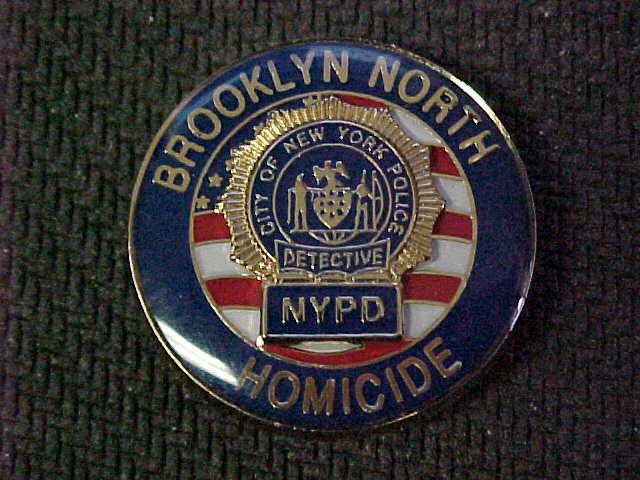
GOYAKOD, the sign that Frank remembered hanging on the squad room wall when he started as a new detective in the 81 Squad back in the early 60�s, and the sign that hangs on the Brooklyn North Homicide Squad office today.
Rule number one in detective work � getting someone to talk to you and tell you what happened. Sometimes the only way to do this is to �pound the pavement�, doing what �gumshoe� work is all about � knocking on doors and talking to people!
Some things never change.
SGT. PATRICK BENEVENTI HONORED
As noted in a recent NY POST article, on June 16, 2004, Sgt. Patrick Beneventi of the 109 Pct. was recently honored.
On June 16, 2004 Police Commissioner Ray Kelly presented the Theodore Roosevelt Award - which honors NYPD cops who survive a medical hardship - to a Queens sergeant who fought back against cancer.
"I had a little bad luck with my health. Thank God everything is OK. I had a little surgery and I feel fine now," said Sgt. Patrick Beneventi.
Beneventi became ill in July 1999 and underwent surgery to remove a malignant tumor from his spine. He returned to work - only to be twice diagnosed with prostate cancer, but he has been cancer-free since March 2003.
The Roosevelt Award honors the legacy of the former NYPD commissioner and childhood asthma victim who became the 26th president.
Kelly lauded Beneventi not only for beating his illness, but for supervising three cops from the 109th Precinct who have had a remarkable impact upon crime in Flushing.
The trio - Officers Brian McCloskey, Dennis Kim and Jerry Svoronos - logged 366 arrests in 2003, an average of an arrest a day. Through March of this year, they had nabbed 157 suspected criminals, a rate nearly twice that of last year.
IF YOGI BERRA WAS A DETECTIVE
The following statements, taken from DD5s, could easily have been written by Yogi Berra if he was a detective.
�They were living domesticatally.
They�re habitating at �
Seeking the location of his whereabouts�
He was of Jamaican assessment.
Seeking to identify his identification.
Identified a pattern of unrelated incidents.
Was wearing a multi-colored white tee shirt
Known to congregate by himself.
The eyewitness is blind and did not see anything.
They went into a feet pursuit.
He has numerical arrests on his rap sheet.
The bus driver was working off duty at the time.
The information was received from an anonymous CI.
His sister states that she is not related to her brother.
The suspicious package was examined and determined to be not suspicious.
The unarmed security guard fired two shots at the perp.
All the calls that day happened another day.
Also, does anyone know when the word �conversating� became a recognized word in the English language?
�LEST WE FORGET�� NYPD Memorial
�It is not how they died that makes them a hero, but how they lived their lives�.
Aug 1, 1913 Ptl Bernard O�Rourke, 146 Pct, Dragged by horse
Aug 2, 1922 Lt Albert Duffy, HQDiv, Explosion investigation
Aug 2, 1966 Ptl Edward Monzillo, Mcy2, Auto pursuit
Aug 2, 1979 Sgt Michael Russell, 75 Pct A/C, Shot:Off duty arrest
Aug 4, 1851 Sgt Michael Foster, NFI
Aug 4, 1913 Ptl Patrick Cotter, 65 Pct, Shot making arrest
Aug 4, 1928 Ptl Arthur Fash, 52 Pct, Electrocuted
Aug 4, 1953 Ptl Henry Ergen, 79 Pct, Assaulted
Aug 5, 1927 Ptl Hubert Allen, 52 Pct, Auto accident on patrol
Aug 6, 1861 Ptl David Martin, 2 Pct, Stabbed during burglary
Aug 6, 1917 Ptl Robert Holmes, 38 Pct, Shot, robbery in progress
Aug 6, 1925 Det Richard Heneberry, DD, Shot-GLA arrest
Aug 6, 1926 Ptl Oscar Oehlerking, 9 Pct, Shot-robbery in progress
Aug 6, 1935 Ptl Thomas Burns, 5 Pct, Injured on patrol
Aug 7, 1927 Ptl. William Goddy, 7 Pct, Line of duty injury
Aug 7, 1928 Sgt James Barry, 9A Pct, Auto accident on patrol
Aug 8, 1926 Ptl Frank Murphy, Mcy Dist, Shot-GLA arrest
Aug 9, 1930 Det Harry Bloomfield, 44 Sq, Shot by prisoner
Aug 11, 1926 Det John Singer, DD, Shot by prisoner
Aug 11, 1937 Det Isadore Astel, MODD, Shot � Robbery in Progress
Aug 11, 1937 Ptl John Bosworth 43 Pct, Trolley Car accident
Aug 11, 1937 Ptl Joseph McBreen ESS10, Building collapse
Aug 11, 1949 Ptl George Connelly 19 Pct, Line of duty accident
Aug 12, 1952 Ptl James McGillion 34 Pct, Shot during investigation
Aug 12, 1966 Ptl Harold Levine Mcy2, Motorcycle accident
Aug 14, 1924 Ptl Frederick Thomas 9 Pct, Shot-robbery investigation
Aug 14, 1980 PO Harry Ryman 60 Pct, Shot-investigation
Aug 15, 1865 Ptl Thomas Walken 29 Pct, Arrest-assault
Aug 16, 1988 PO Joseph Galapo BSNarco, Shot during arrest
Aug 17, 1947 Ptl Thomas Gargan 6 Pct, Shot-burglary in progress
Aug 17, 1969 Sgt Cornelius McGowan 114 Pct, Line of duty heart attack
Aug 17, 1979 PO Thomas Schimenti, MTS Pct, Shot-robberyAug 19, 1974 Ptl Thomas Pegues, TPF, Shot-auto checkAug 20, 1971 Ptl Kenneth Nugent, 103 Pct, Shot-robberyAug 20, 1987 Det Myron Parker, BxNarco, AssaultedAug 21, 1931 Ptl Walter Webb, 40 Pct, Shot-Robbery in progressAug 21, 1931 Ptl Edwin Churchill, McyDist, Shot-robbery in progressAug 22, 1924 Ptl Harry Blumberg, 10 Pct, Auto accident on patrolAug 22, 1925 Ptl David Sheehan, 4 Pct, Shot-burglary arrestAug 22, 1941 Ptl Harold King, TrafficB, Shot-GLA arrest
August 25, 1864 Ptl John OBrien, 19 Pct, Arrest-robbery
August 25, 1928 Ptl Joseph Dursee, 8A Pct, Shot-robbery in progress
August 25, 1946 Ptl Michael Zawoltk, Traffic K, Shot during arrest
August 26, 1918 Ptl William Barrett, 13 Pct, Thrown from horse
August 26, 1936 Ptl Richard McCormack, 20 Pct, Injured on patrol
August 26, 1971 Sgt Joseph Morabito, 1Div Narco, Shot during investigation
August 27, 1921 Ptl Daniel Neville, 23 Pct, Shot during investigation
August 28, 1939 Ptl Clarence Mihlheiser, Hwy3, Auto accident on patrol
August 28, 2002 PO Disdale Enton, 113 Pct, LOD injury chasing perp
August 29, 1977 Det Joseph Taylor, 83 Pct, Shot during investigation
August 31, 1962 Ptl Nicholas Panico, 62 Pct, Shot by EDP
August 31, 1969 Ptl Kenneth Keller, 19 Pct, LOD heart attack
Sixty years after the Medal of Honor replaced the Department Medal as the NYPD�s top award for valor, the department decided to change its design.
In 1972, a contest was announced to pick a design for a new medal. The winner was Ptl. Alfred Young, a police historian and later curator of the Police Museum. His design was based on the star-shaped badge worn by the New York City Municipal Police Department officers from 1845 to 1857. The medal hangs from a green ribbon on which 12 white stars are clustered. A top bar is inscribed with �Valor�. A gold palm leaf on the ribbon indicates a second award. Since 1997, the medal has been made of gold.
The first presentation of the new medals were made on October 23, 1973, to the widows of five officers: Gregory Foster and Rocco Laurie, 9 Pct., Elijah Stroud, 88 Pct., Phillip Cardillo, 28 Pct., and Det. William Capers, 16 B/L Sqd, who were slain in the line of duty during 1972. Two other awards of the Medal of Honor were also made that day to Sgt. William Manos, ESD 4, and Officer Frank Buono, Bx. FSA.
At the 1985 Medal Day ceremonies the first awards of the NYPD Medal of Honor to a female police officer were made to PO Tanya Braithwaite, 41 Pct, and PO Sharon Fields, 40 Pct. Each officer had engaged in a shootout with a gunman who had just murdered another police officer.
It is noted that in 1984, a female police officer with the NYC Transit Police Department, Irma Lozada, was killed in the line of duty and awarded the Transit Police� Medal of Honor posthumously.
Since 1921, when posthumous awards were first made, approximately 70% of the Medals of Honor awarded have been to officers who died in the line of duty, with the majority killed in shooting incident.
IN MEMORIAM: PTL. DANIEL NEVILLE
On August 27, 1921 Ptl. Daniel J. Neville of the 23rd Precinct (Midtown South) was killed in the line of duty.
Ptl. Neville entered a lot at 39th St. and Eleventh Ave. to investigate a report that a group of young gangsters were using the watchman�s shanty for card games and for the distribution of drugs. When he was about five foot from the shanty he was shot in the left chest, which resulted in his death. Witnesses had reported that they saw one man run out of the yard and that two men were seen climbing over the fence of the year after the shot.
Ptl. Neville was appointed to the NYPD in 1907; he was married and the father of five children. Ptl. Neville was Posthomously awarded the NYPD Medal of Honor.
(Special Note: In 1918, One of Ptl. Neville�s former partners, Ptl. Joseph Nolan, was killed in front of 526 W. 39th Street by a brick thrown from the roof ).
IDENTITY THEFT INVESTIGATORS GUIDE AVAILABLE
A recently release publication by the national Institute of Justice focuses on the ever increasing problem of Identity Theft.
Law Enforcement Agencies and Identity Theft, (NCJ 205701) a 64 page booklet, is a new COPS POP Guide, addresses the problem of identity theft, and reviews the factors that increase the risk of it. Identity theft is a new crime, facilitated through established, underlying crimes such as forgery, counterfeiting, check and credit card fraud, computer fraud, impersonation, pickpocketing, and even terrorism.
You Can Access full text at COPS Online:
http://www.cops.usdoj.gov/mime/open.pdf?Item=1271
CRIME BEAT, BY MICHAEL CONNELLY
Michael Connelly is better known as the best-selling author of the Harry Bosch series of crime novels, all taking place in Los Angeles. His more popular works include THE CLOSERS and THE NARROWS, along with the bestselling novels THE LINCOLN LAWYER and BLOOD WORK.
Connelly got his start as a journalist, working as a crime reporter in South Florida covering the detectives who worked the homicide beat.
His latest book is a collection of some of his true crime stories, taken from these earlier newspaper pieces. It will make a decent �summer read�, as I found it to be somewhat interesting, but probably a lot more so for someone who doesn�t do this every day for a living.
I particularly found interesting two items that he mentions early on in this book, in his first chapter, taken from the story he wrote for the Florida Sun-Sentinel in 1987 after spending a week with the Ft Lauderdale Homicide Squad.
He describes homicides in two categories � �whodunit� cases and �smoking gun� cases. These are the cases I have heard referred to as �mysteries� and �ground balls�.
No matter where you are some things never change when it comes to homicide investigations.
One of them is time.
�There is a rule to murder investigations; as more time elapses in a case, the chances of solving it grow slimmer�.
This is one of the key points I try to bring out when teaching at the Homicide Course and instructing new detectives. He also states that �whenever possible, depending on constrictions of time, the overtime budget, fatigue and so on, all available hands are put on the initial stages of a case�.
That�s the very point I make when I discuss the �24 & 72 Rule� of homicide investigations � go back on your victim�s last 24 hours to help decipher the motive, and the suspect; and the effort you put into the first 72 hours of the investigation will lay the foundation for success or failure in your investigation.
The second item of interest is one that many of the veteran detectives will also appreciate, and one that Ret. Capt. Frank Bolz brought to my attention several years ago.
On the wall in the Ft. Lauderdale Homicide Squad�s office was a sign that says �Get off your ass and knock on doors.�
GOYAKOD, the sign that Frank remembered hanging on the squad room wall when he started as a new detective in the 81 Squad back in the early 60�s, and the sign that hangs on the Brooklyn North Homicide Squad office today.
Rule number one in detective work � getting someone to talk to you and tell you what happened. Sometimes the only way to do this is to �pound the pavement�, doing what �gumshoe� work is all about � knocking on doors and talking to people!
Some things never change.
SGT. PATRICK BENEVENTI HONORED
As noted in a recent NY POST article, on June 16, 2004, Sgt. Patrick Beneventi of the 109 Pct. was recently honored.
On June 16, 2004 Police Commissioner Ray Kelly presented the Theodore Roosevelt Award - which honors NYPD cops who survive a medical hardship - to a Queens sergeant who fought back against cancer.
"I had a little bad luck with my health. Thank God everything is OK. I had a little surgery and I feel fine now," said Sgt. Patrick Beneventi.
Beneventi became ill in July 1999 and underwent surgery to remove a malignant tumor from his spine. He returned to work - only to be twice diagnosed with prostate cancer, but he has been cancer-free since March 2003.
The Roosevelt Award honors the legacy of the former NYPD commissioner and childhood asthma victim who became the 26th president.
Kelly lauded Beneventi not only for beating his illness, but for supervising three cops from the 109th Precinct who have had a remarkable impact upon crime in Flushing.
The trio - Officers Brian McCloskey, Dennis Kim and Jerry Svoronos - logged 366 arrests in 2003, an average of an arrest a day. Through March of this year, they had nabbed 157 suspected criminals, a rate nearly twice that of last year.
IF YOGI BERRA WAS A DETECTIVE
The following statements, taken from DD5s, could easily have been written by Yogi Berra if he was a detective.
�They were living domesticatally.
They�re habitating at �
Seeking the location of his whereabouts�
He was of Jamaican assessment.
Seeking to identify his identification.
Identified a pattern of unrelated incidents.
Was wearing a multi-colored white tee shirt
Known to congregate by himself.
The eyewitness is blind and did not see anything.
They went into a feet pursuit.
He has numerical arrests on his rap sheet.
The bus driver was working off duty at the time.
The information was received from an anonymous CI.
His sister states that she is not related to her brother.
The suspicious package was examined and determined to be not suspicious.
The unarmed security guard fired two shots at the perp.
All the calls that day happened another day.
Also, does anyone know when the word �conversating� became a recognized word in the English language?
�LEST WE FORGET�� NYPD Memorial
�It is not how they died that makes them a hero, but how they lived their lives�.
Aug 1, 1913 Ptl Bernard O�Rourke, 146 Pct, Dragged by horse
Aug 2, 1922 Lt Albert Duffy, HQDiv, Explosion investigation
Aug 2, 1966 Ptl Edward Monzillo, Mcy2, Auto pursuit
Aug 2, 1979 Sgt Michael Russell, 75 Pct A/C, Shot:Off duty arrest
Aug 4, 1851 Sgt Michael Foster, NFI
Aug 4, 1913 Ptl Patrick Cotter, 65 Pct, Shot making arrest
Aug 4, 1928 Ptl Arthur Fash, 52 Pct, Electrocuted
Aug 4, 1953 Ptl Henry Ergen, 79 Pct, Assaulted
Aug 5, 1927 Ptl Hubert Allen, 52 Pct, Auto accident on patrol
Aug 6, 1861 Ptl David Martin, 2 Pct, Stabbed during burglary
Aug 6, 1917 Ptl Robert Holmes, 38 Pct, Shot, robbery in progress
Aug 6, 1925 Det Richard Heneberry, DD, Shot-GLA arrest
Aug 6, 1926 Ptl Oscar Oehlerking, 9 Pct, Shot-robbery in progress
Aug 6, 1935 Ptl Thomas Burns, 5 Pct, Injured on patrol
Aug 7, 1927 Ptl. William Goddy, 7 Pct, Line of duty injury
Aug 7, 1928 Sgt James Barry, 9A Pct, Auto accident on patrol
Aug 8, 1926 Ptl Frank Murphy, Mcy Dist, Shot-GLA arrest
Aug 9, 1930 Det Harry Bloomfield, 44 Sq, Shot by prisoner
Aug 11, 1926 Det John Singer, DD, Shot by prisoner
Aug 11, 1937 Det Isadore Astel, MODD, Shot � Robbery in Progress
Aug 11, 1937 Ptl John Bosworth 43 Pct, Trolley Car accident
Aug 11, 1937 Ptl Joseph McBreen ESS10, Building collapse
Aug 11, 1949 Ptl George Connelly 19 Pct, Line of duty accident
Aug 12, 1952 Ptl James McGillion 34 Pct, Shot during investigation
Aug 12, 1966 Ptl Harold Levine Mcy2, Motorcycle accident
Aug 14, 1924 Ptl Frederick Thomas 9 Pct, Shot-robbery investigation
Aug 14, 1980 PO Harry Ryman 60 Pct, Shot-investigation
Aug 15, 1865 Ptl Thomas Walken 29 Pct, Arrest-assault
Aug 16, 1988 PO Joseph Galapo BSNarco, Shot during arrest
Aug 17, 1947 Ptl Thomas Gargan 6 Pct, Shot-burglary in progress
Aug 17, 1969 Sgt Cornelius McGowan 114 Pct, Line of duty heart attack
Aug 17, 1979 PO Thomas Schimenti, MTS Pct, Shot-robberyAug 19, 1974 Ptl Thomas Pegues, TPF, Shot-auto checkAug 20, 1971 Ptl Kenneth Nugent, 103 Pct, Shot-robberyAug 20, 1987 Det Myron Parker, BxNarco, AssaultedAug 21, 1931 Ptl Walter Webb, 40 Pct, Shot-Robbery in progressAug 21, 1931 Ptl Edwin Churchill, McyDist, Shot-robbery in progressAug 22, 1924 Ptl Harry Blumberg, 10 Pct, Auto accident on patrolAug 22, 1925 Ptl David Sheehan, 4 Pct, Shot-burglary arrestAug 22, 1941 Ptl Harold King, TrafficB, Shot-GLA arrest
August 25, 1864 Ptl John OBrien, 19 Pct, Arrest-robbery
August 25, 1928 Ptl Joseph Dursee, 8A Pct, Shot-robbery in progress
August 25, 1946 Ptl Michael Zawoltk, Traffic K, Shot during arrest
August 26, 1918 Ptl William Barrett, 13 Pct, Thrown from horse
August 26, 1936 Ptl Richard McCormack, 20 Pct, Injured on patrol
August 26, 1971 Sgt Joseph Morabito, 1Div Narco, Shot during investigation
August 27, 1921 Ptl Daniel Neville, 23 Pct, Shot during investigation
August 28, 1939 Ptl Clarence Mihlheiser, Hwy3, Auto accident on patrol
August 28, 2002 PO Disdale Enton, 113 Pct, LOD injury chasing perp
August 29, 1977 Det Joseph Taylor, 83 Pct, Shot during investigation
August 31, 1962 Ptl Nicholas Panico, 62 Pct, Shot by EDP
August 31, 1969 Ptl Kenneth Keller, 19 Pct, LOD heart attack